


The Silent ROI Killer: Technical Debt and Integration in Agentic AI Architecture
Agentic AI represents a shift from simple "chatbots" to autonomous reasoning systems. However, most companies are currently building on "technical quicksand", relying on brittle GPT-wrappers and un-orchestrated scripts. This creates massive technical debt that erodes ROI. This guide explores how to build production-grade architectures using stateful orchestration (LangGraph, CrewAI), integrate with legacy CRMs, and eliminate the "AI tax" through proper systems engineering.
The Mirage of the "Quick Win" AI
Everyone wants the "magic" button. You see a demo of a GPT-4 script that handles a lead, and it looks like a 10x win. You deploy it. Three weeks later, the script breaks because a field in your CRM changed. Or the LLM hallucinated a price, and there’s no audit trail to find out why.
McKinsey reports that technical debt already consumes 40% of IT budgets in large enterprises. In the world of agentic intelligence, that debt doesn't just slow you down, it kills your ROI. If your "autonomous" agent requires a developer to babysit it every time an API updates, it’s not an agent. It’s a liability.
At Agix Technologies, we see this constantly: Founders and Ops Leads building "Wrapped GPTs" that fail the moment they hit real-world complexity. To win, you need to stop thinking about prompts and start thinking about systems engineering.
The Cost of "Wrapped GPT" Technical Debt
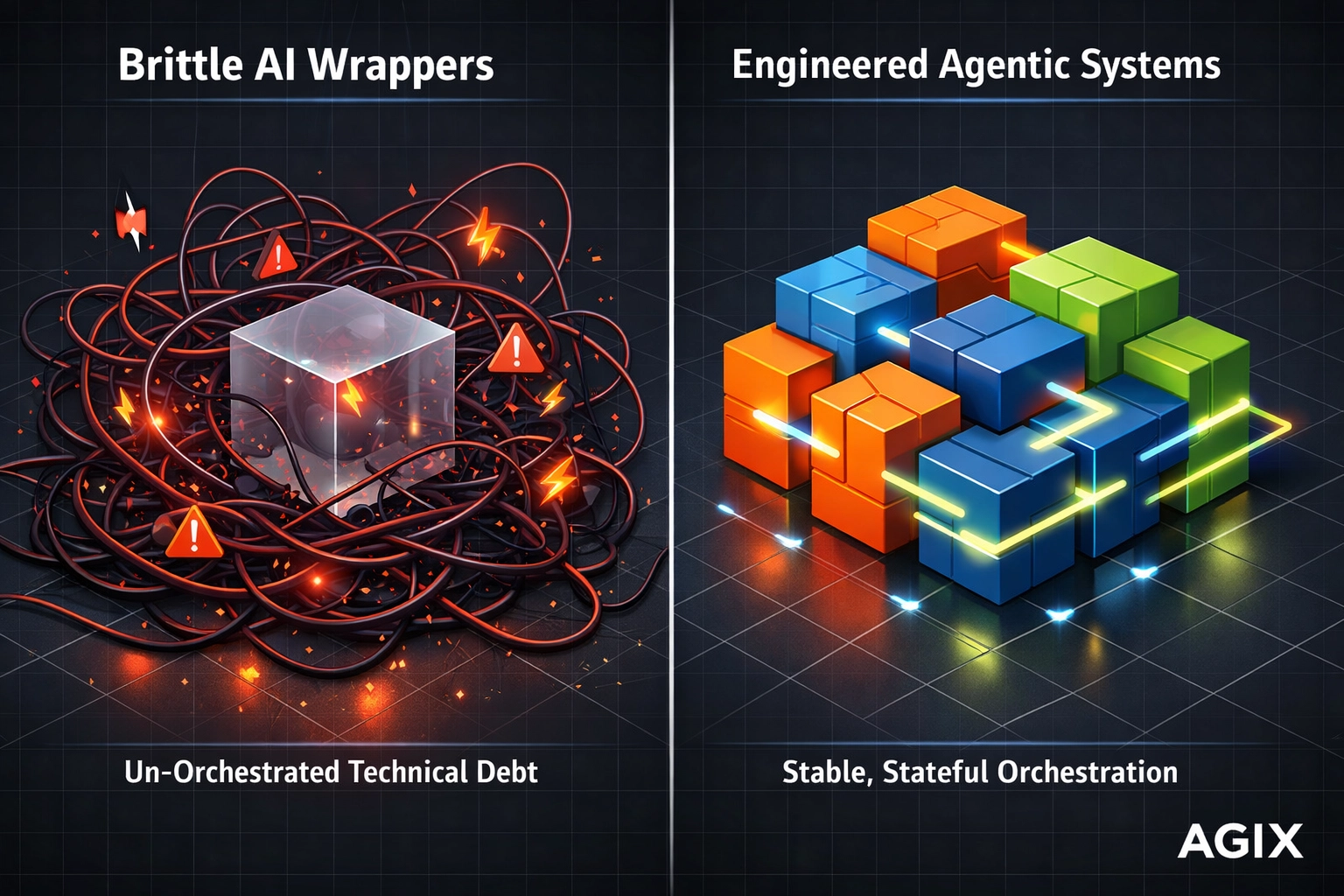
Most initial AI forays are "wrappers." They are thin layers of code around an LLM API. While great for a proof of concept, they create a massive maintenance burden.
- Lack of State Memory: Simple scripts don't remember what happened ten minutes ago in a different thread. Without "Persistent State," your agents are goldfish.
- Brittle Integration: Hard-coded API calls to your CRM or ERP break. Production-grade agents need autonomous thinking to navigate schema changes.
- The "Black Box" Problem: If you don't orchestrate your scripts, you can't debug them. You don't know if the failure happened at the LLM reasoning level, the data retrieval level, or the execution level.
Architectural Integration: Moving Beyond Scripted Chaos
Scaling AI isn't about the model you use (though choosing between Gemini Flash and GPT-4o Mini matters). It’s about how that model interacts with your legacy stack.
Most companies have a "Frankenstein" stack: a 10-year-old CRM, a modern Slack-based internal comms system, and several siloed databases. Bringing Agentic AI into this mix requires an API-First, Event-Driven Architecture.
How to Weave AI into Legacy Systems:
- The Translation Layer: Don't point your agent directly at a legacy SQL database. Use a RAG (Retrieval-Augmented Generation) knowledge base to act as an abstraction layer.
- Event Hooks: Instead of the agent "polling" for new leads, your CRM should trigger the agent via webhooks. This reduces latency and compute costs.
- Human-in-the-Loop (HITL): High-ROI systems don't remove humans; they empower them. Proper architecture includes checkpoints where an agent pauses for human approval before executing high-stakes tasks, like sending a contract or updating a billing record.
Tooling Battle: LangGraph vs. CrewAI vs. The Persistent State
To manage complex workflows, you need an orchestration framework. Two names dominate the conversation: LangGraph and CrewAI.
| Feature | LangGraph | CrewAI |
|---|---|---|
| Logic Type | Cyclic (Graphs) | Linear/Sequential |
| State Management | High (Built-in persistence) | Moderate |
| Control | Fine-grained (Developer-centric) | High-level (Process-centric) |
| Best Use Case | Complex, multi-step reasoning | Role-based agent "crews" |
Why "Persistent State" is Non-Negotiable:
In enterprise AI scaling, state is the ability of the system to save its progress. If an agent is halfway through a 10-step procurement process and the server restarts, does it start over? Without persistent state, yes. This wastes tokens, time, and money.
LangGraph allows for "check-pointing," meaning the agent can pick up exactly where it left off. This is the difference between a toy and a tool.
Calculating the ROI of Clean AI Systems Engineering
Proper architecture prevents the "AI Tax" from eating your profits. When you invest in agentic AI systems from the start, your cost per task drops over time.
- Initial Investment: Higher (due to architectural setup).
- Maintenance Cost: -70% compared to "scripted" AI.
- Reliability: 99.9% (vs. ~80% for non-orchestrated scripts).
- Speed to Market: Faster, because new "skills" can be plugged into the existing graph rather than rewritten from scratch.
By retiring technical debt early, you aren't just saving money; you're building a foundation that competitors using "off-the-shelf" wrappers simply cannot match. You move from 24-hour batch processing to millisecond real-time intelligence.
The Agix Technologies Advantage
At Agix Technologies, we don't just "build bots." We engineer agentic intelligence that fits into your existing business flow. Whether it’s conversational AI for customer support or complex AI voice agents for sales, we focus on the underlying architecture first.
LLM Access Paths: Using This Guide with AI Tools
You can use the insights in this post to prompt your preferred LLM for better architectural advice.
- ChatGPT/Claude: "I'm building an Agentic AI workflow using LangGraph. Based on the principles of persistent state and reducing technical debt, how should I structure my graph to handle a 'Human-in-the-Loop' checkpoint for a CRM update?"
- Perplexity: "Search for the latest comparison between LangGraph and CrewAI for enterprise-level state management and ROI impact."
FAQ: Technical Debt & AI Architecture
1. What is AI technical debt?
It’s the long-term cost of choosing an easy, "hacky" solution (like a simple Python script using an LLM API) over a robust, orchestrated architecture.
2. Why do "Wrapped GPTs" fail in production?
They lack memory, can't handle complex errors, and are difficult to update when your external tools (like CRMs) change their API.
3. Is CrewAI better than LangGraph?
CrewAI is great for role-playing and simpler tasks. LangGraph is superior for complex, cyclic reasoning where fine-grained control and state persistence are required.
4. How does persistent state save money?
It allows agents to resume tasks after interruptions without re-processing the entire sequence, saving on token costs and compute time.
5. Can I integrate Agentic AI with an old legacy CRM?
Yes, by using an API translation layer or a RAG-based knowledge base to act as a bridge between the agent and the old system.
6. What is the "AI Tax"?
The hidden cost of manual intervention, debugging, and wasted tokens caused by poorly designed AI systems.
7. How do I start retiring my AI technical debt?
Audit your current scripts. If they are linear and lack error handling, consider migrating them to a graph-based orchestration framework.
8. What role does "Human-in-the-Loop" play in architecture?
It acts as a safety valve, allowing humans to verify high-stakes AI decisions, which is critical for compliance and accuracy.
9. How does Agix Technologies handle integration?
We use an AI systems engineering approach, building event-driven architectures that sync seamlessly with your existing tech stack.
10. What is the average ROI of switching to orchestrated AI?
While initial setup costs are higher, companies typically see a 50% reduction in maintenance time and a significant increase in task completion reliability.

 Arabic
 French
 Spanish
 Portuguese
 Deutsch
 Turkish
 Dutch
Dutch
 Italiano
 Russian
 Romaian
 Portuguese (Brazil)
 Greek
Greek