


ISO 9001 Certification Cost in India: A Complete Guide for Businesses
In today’s competitive business environment, maintaining quality is not just a choice it’s a necessity. This is where ISO 9001 certification comes into play. It is one of the most recognized quality management standards globally and helps organizations streamline processes, improve efficiency, and enhance customer satisfaction.
However, one of the most common questions businesses ask is: What is the ISO 9001 certification cost in India? The answer isn’t straightforward, as the cost depends on multiple factors. In this blog, we’ll break down everything you need to know in a simple and humanized way, so you can plan better for your certification journey.
What is ISO 9001 Certification?
ISO 9001 is a standard for Quality Management Systems (QMS) developed by the International Organization for Standardization. It provides a framework for businesses to ensure consistent quality in products and services.
From small startups to large enterprises, companies across India are adopting ISO 9001 to improve internal processes and build trust with customers.
Why Businesses in India Choose ISO 9001
Before diving into the cost, it’s important to understand why businesses invest in ISO 9001 certification:
-
Improved operational efficiency
-
Better customer satisfaction
-
Enhanced brand credibility
-
Increased chances of winning tenders
-
Better decision-making through structured processes
For many organizations, the benefits outweigh the investment, making ISO 9001 a valuable long-term asset.
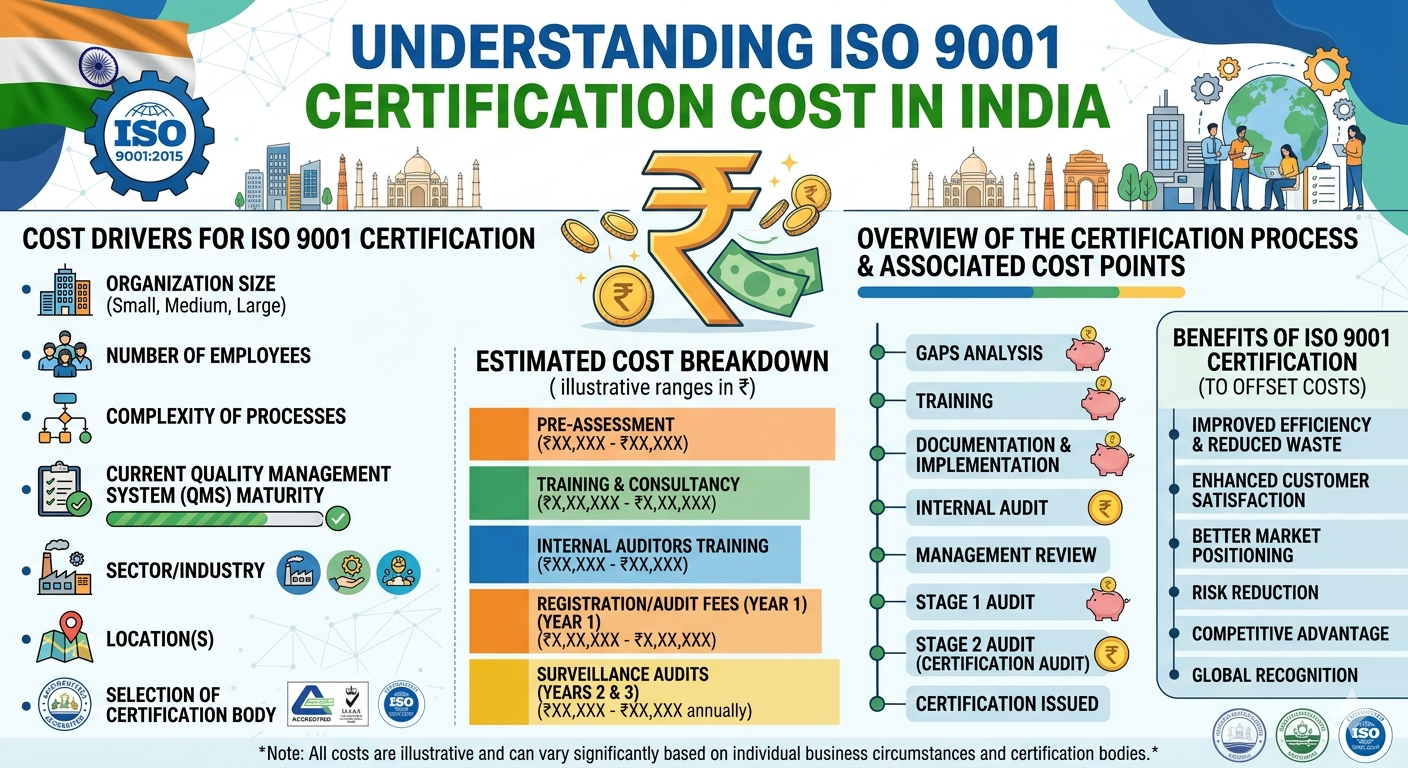
ISO 9001 Certification Cost in India: Key Factors
The cost of ISO 9001 certification in India varies widely depending on several factors. Let’s explore each one in detail.
1. Size of the Organization
The number of employees plays a major role in determining the cost.
-
Small businesses (5–20 employees) generally have lower certification costs
-
Medium-sized businesses may incur moderate costs
-
Large organizations with multiple departments and locations will have higher costs
This is because larger organizations require more extensive audits and documentation.
2. Nature of Business
Different industries have different complexities. For example:
-
A service-based company may have simpler processes
-
A manufacturing unit may require detailed quality checks and documentation
The more complex your operations, the higher the certification cost is likely to be.
3. Number of Locations
If your business operates from multiple locations, the certification body will need to audit each site. This increases:
-
Audit time
-
Travel expenses
-
Overall certification cost
Single-location businesses typically pay less compared to multi-location organizations.
4. Certification Body Fees
Certification bodies charge fees for:
-
Initial audit
-
Surveillance audits (usually yearly)
-
Recertification (every 3 years)
The fees may vary depending on the certification body you choose and their accreditation level.
5. Consultancy Charges
Many businesses choose to work with consultants like js certification to simplify the process. Consultants help with:
-
Documentation
-
Process implementation
-
Training
-
Audit preparation
While consultancy adds to the cost, it can save time and reduce errors, especially for first-time applicants.
6. Documentation and Implementation
ISO 9001 requires proper documentation of processes, policies, and procedures. Costs may include:
-
Creating manuals and SOPs
-
Employee training
-
Internal audits
If your business already has structured processes, the cost may be lower.
Hidden Costs You Should Know
Many businesses focus only on the initial certification fee but overlook hidden costs. These may include:
-
Employee training time
-
Process restructuring
-
Internal resource allocation
-
Maintenance of documentation
Understanding these costs in advance can help you avoid surprises later.
How to Reduce ISO 9001 Certification Cost
While certification requires investment, there are ways to optimize your costs:
1. Prepare Internally
If you already have basic processes in place, you’ll spend less on consultancy and documentation.
2. Train Your Team
Having a trained internal team reduces dependency on external consultants.
3. Choose the Right Certification Partner
Working with experienced consultants like js certification can help avoid costly mistakes and delays.
4. Keep Documentation Simple
Avoid over-complicating processes. Simple and practical documentation reduces both cost and effort.
How Long Does the Certification Process Take?
Time is also a factor linked to cost. Typically:
-
Small businesses: Few weeks
-
Medium businesses: 1–2 months
-
Large organizations: 2–3 months or more
Delays in documentation or audits can increase both time and cost.
Final Thoughts
Understanding the ISO 9001 certification cost in India is crucial for businesses planning to get certified. While the cost may vary based on size, industry, and requirements, the long-term benefits make it a worthwhile investment.
Instead of focusing only on the price, businesses should look at the value it brings—better processes, improved quality, and stronger customer trust.
If you approach the certification process with proper planning and the right guidance, it becomes much smoother and more cost-effective. Whether you’re a startup or an established organization, ISO 9001 can be a stepping stone toward sustainable growth and success.
FAQs
1. Is ISO 9001 certification mandatory in India?
No, it is not mandatory, but it is highly recommended for improving quality and credibility.
2. How long is ISO 9001 certification valid?
It is valid for three years, with annual surveillance audits.
3. Can small businesses afford ISO 9001?
Yes, there are cost-effective options available for small businesses

 Arabic
 French
 Spanish
 Portuguese
 Deutsch
 Turkish
 Dutch
Dutch
 Italiano
 Russian
 Romaian
 Portuguese (Brazil)
 Greek
Greek