


Urea Market Size, Share, Growth and Forecast 2026 | USD 61.1 Billion by 2034
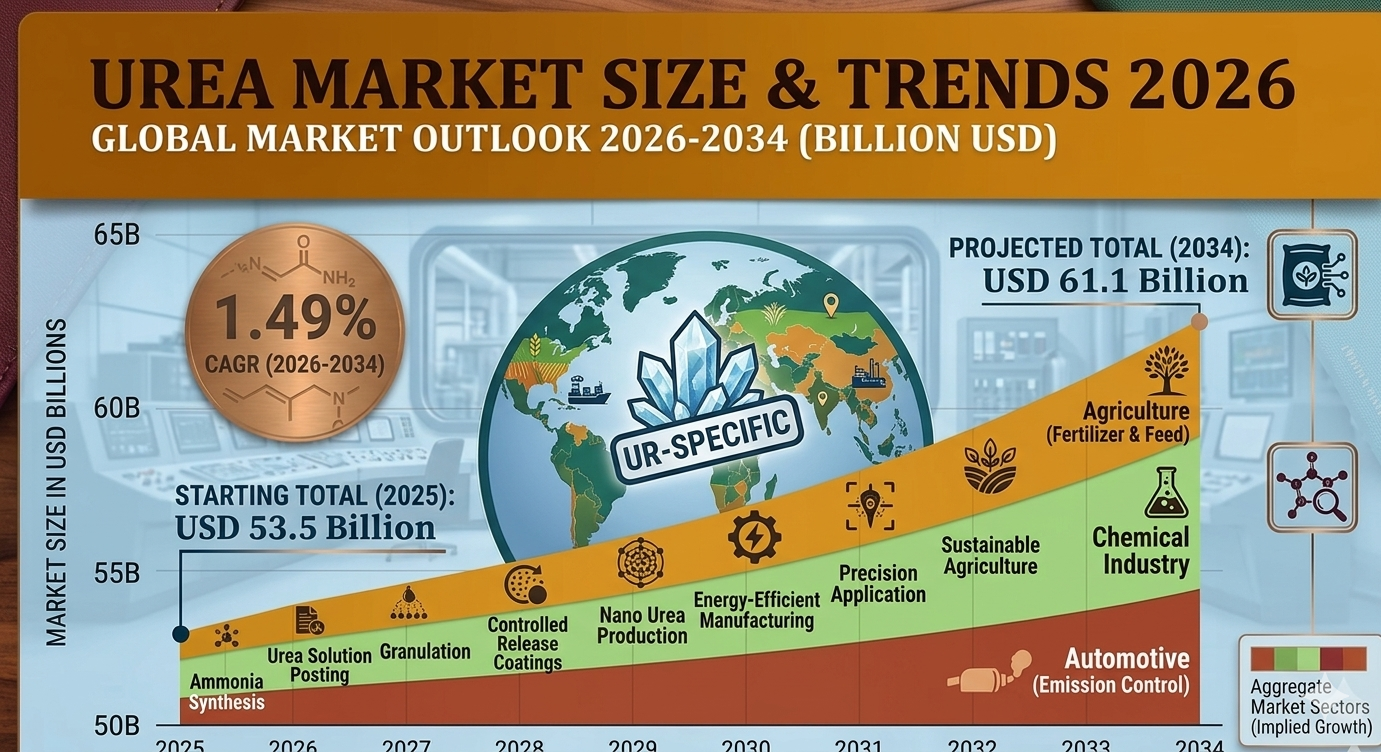
According to a research report by IMARC Group, the global urea market size was valued at USD 53.5 Billion in 2025. Looking forward, IMARC Group estimates the market to reach USD 61.1 Billion by 2034, exhibiting a growth rate (CAGR) of 1.49% during 2026–2034. Asia-Pacific currently dominates the market, holding a significant market share of over 45.2% in 2025. The market is primarily driven by increasing agricultural demand for nitrogen-based fertilizers, growing global food demand necessitating higher crop yields, ongoing advancements in urea production technology, and favorable government policies supporting agricultural productivity.
Market at a Glance
|
Report Attribute |
Key Statistics |
|
Base Year |
2025 |
|
Forecast Years |
2026–2034 |
|
Historical Years |
2020–2025 |
|
Market Size in 2025 |
USD 53.5 Billion |
|
Market Forecast in 2034 |
USD 61.1 Billion |
|
Market Growth Rate (CAGR) |
1.49% |
|
Largest Regional Market |
Asia-Pacific (45.2%+ share in 2025) |
Request for a Sample Report for Detailed Evaluation: https://www.imarcgroup.com/urea-market/requestsample
Key Urea Market Trends Driving Expansion
Rising Demand for Nitrogen-Based Fertilizers
One of the most prominent urea market trends is the escalating global demand for nitrogen-based fertilizers in agriculture. Global fertilizer consumption is expected to recover by 4% reaching 192.5 Million Metric Tons (mmt), with nitrogen fertilizer consumption estimated at 108 mmt and production at 109 mmt. Urea is a key source of nitrogen, essential for plant growth and crop yield improvement. Projections from the FAO indicate that to feed a global population of 9.1 billion by 2050, overall food production must increase by approximately 70%, with production in developing countries nearly doubling. This sustained agricultural pressure is creating a strongly positive urea market outlook across the globe.
Significant Advancements in Urea Production Technology
Technological advancements in urea production have significantly boosted market growth. Innovations such as more efficient production processes, cost-effective methods, and environmentally friendly technologies have made urea manufacturing more viable and sustainable. These advancements reduce production costs while improving the quality and consistency of urea, making it a more attractive option for agricultural and industrial applications. A prominent example is the July 2024 selection of NEXTCHEM — a division of MAIRE — by Linggu Chemical Co. Ltd. to enhance the energy efficiency of a 3,100 metric tons per day urea plant in China using Advanced MP Flash Design technology, aiming to reduce the plant's energy consumption by up to 20% by optimizing steam usage and feedstock utilization.
Supportive Government Policies and Subsidies
Supportive government policies and subsidies for agricultural inputs play a crucial role in driving the urea market toward growth. Governments worldwide are implementing policies to promote agricultural productivity and ensure food security. In India, the government introduced a USD 2 Billion nitrogenous fertilizer subsidy scheme and is working to stop urea imports by the end of 2025 through a two-pronged strategy — reviving closed urea plants and promoting alternative fertilizers like nano liquid urea. Domestic production capacity has already increased to 310 Lakh Tons, with a target of 325 Lakh Tons annually, reflecting the central role government action plays in shaping urea market demand.
Expanding Industrial and Automotive Applications
Beyond agriculture, expanding industrial and automotive applications are broadening the urea market's demand base. Urea is extensively utilized in manufacturing resins, adhesives, and plastics, and is a critical ingredient in Selective Catalytic Reduction (SCR) systems that reduce nitrogen oxide emissions from diesel vehicles. As environmental regulations tighten globally, the automotive sector's reliance on urea-based diesel exhaust fluid (DEF) is growing rapidly. In Europe alone, approximately 10.6 million new vehicles were registered in the EU in 2023, a 14% increase from 2022, directly amplifying demand for urea in emissions control systems.
Urea Market Segmentation Analysis
By Grade
• Fertilizers Grade
• Feed Grade
• Technical Grade
Technical Grade holds the largest market share at around 55.0% in 2025 - owing to its diverse industrial applications beyond agriculture. It is a key component in the manufacturing of resins, adhesives, and coatings widely used in automotive, construction, and furniture industries. Technical grade urea is also crucial in the production of diesel exhaust fluid (DEF) for reducing nitrogen oxide emissions, and its role in pharmaceuticals, cosmetics, and as a de-icing agent further reinforces its market dominance.
By Application
• Nitrogenous Fertilizer
• Stabilizing Agent
• Keratolyte
• Resin
• Others
Nitrogenous Fertilizer leads the market with approximately 53.8% of market share in 2025 - as urea, a highly concentrated nitrogen source, is essential for promoting plant growth and increasing crop yields. Its efficiency, cost-effectiveness, and ease of application make it the preferred choice among farmers worldwide. With the growing global population and the consequent need for enhanced agricultural productivity, production capacity is projected to increase by 6% reaching 202 Million Tons by 2027.
By End-Use Industry
• Agriculture
• Chemical
• Automotive
• Medical
• Others
Agriculture leads the market with approximately 74.7% of market share in 2025 - as urea's role as a nitrogen fertilizer is crucial for promoting plant growth and increasing crop yields. Its cost-effectiveness, ease of application, and suitability for diverse crops make it a preferred choice among farmers globally. The growing global population and rising food demand are continuously driving the agricultural sector to enhance productivity, reinforcing urea's dominant market position.
By Region
• Asia Pacific
• North America
• Europe
• Latin America
• Middle East and Africa
Asia-Pacific leads the global market with over 45.2% market share in 2025 - driven by high population density in countries like China and India necessitating significant agricultural productivity. India's domestic urea production increased by 13.4% in 2023, reaching 31.11 Million Tons. Government initiatives, subsidies, and rapid industrialization further support urea production and usage across the region. China's fertilizer industry, one of the largest globally, is also transitioning towards sustainability and efficiency aligned with its 2030 carbon peak and 2060 carbon neutrality goals.
Connect for Detailed Segmentation Analysis - Speak to an Analyst: https://www.imarcgroup.com/request?type=report&id=2053&flag=C
Competitive Landscape in the Urea Industry
The global urea market features a competitive landscape shaped by large multinational corporations and regional players investing heavily in production capacity expansion, energy-efficient manufacturing, and carbon capture technologies. Strategic mergers, acquisitions, and collaborations are assisting companies in enhancing supply chains and optimizing distribution networks. Sustainability and environmental compliance are increasingly central to competitive strategy across the industry.
Key Urea Market Players Include:
• Acron Group
• BASF SE
• BIP (Oldbury) Limited
• EuroChem
• Jiangsu Sanmu Group Co. Ltd.
• Koch Fertilizer LLC
• OCI N.V.
• Petrobras
• Qatar Fertiliser Company
• SABIC
• Yara International ASA
Key Regional Insights
Asia-Pacific - Dominant Market Leader
Asia-Pacific's market leadership is underpinned by the region's vast agricultural base and rapidly growing industrial sector. India and China together account for the majority of regional demand, with both governments implementing strong subsidy and self-sufficiency programs. India's urea availability rose by 3.65% to 41.16 Million Tons in 2023, while sales grew by 3.25% to 38.11 Million Tonnes, reflecting the scale of domestic consumption. China's Belt and Road Initiative (BRI) further supports the fertilizer industry by expanding access to raw materials and new export markets.
North America - Technology and Industrial Demand
The United States accounts for over 84.20% of the urea market in North America, driven by its large agricultural sector and a rapidly expanding chemical manufacturing industry. Total foreign direct investment in U.S. chemical manufacturing totaled USD 766.7 billion in 2023, sustaining strong demand for urea as a primary feedstock. The growing agrochemicals, plastics, and pharmaceuticals sectors, combined with precision agriculture adoption, are expected to continue fueling urea demand.
Europe - Automotive Emissions Regulations
Europe's urea demand is significantly driven by the automotive sector's need to meet stringent environmental regulations. With approximately 10.6 million new vehicles registered across the EU in 2023, the use of urea in Selective Catalytic Reduction (SCR) systems to decrease nitrogen oxide emissions from diesel engines is expanding steadily. Rising industrial demand in pharmaceuticals and manufacturing further adds to Europe's urea consumption profile.
Market Drivers, Challenges & Opportunities
Major Market Drivers:
• Increasing global agricultural demand for nitrogen-based fertilizers to support food security.
• Technological advancements improving urea production efficiency and reducing costs.
• Government subsidies and self-sufficiency programs accelerating domestic production and consumption.
• Growing automotive industry demand for urea in emissions control (SCR systems).
Key Challenges:
• Volatility in natural gas prices (key feedstock for urea production) affecting production costs.
• Environmental concerns around nitrogen runoff and over-fertilization in intensive agricultural regions.
Emerging Opportunities:
• Rising adoption of nano liquid urea and slow-release urea formulations for improved nutrient efficiency.
• Decarbonization initiatives and green ammonia technologies opening sustainable urea production pathways.
• Expansion of urea applications in the construction and building materials sector across Middle East and Africa.
Latest News & Developments
• November 2024: National Fertilizers (NFL) began manufacturing nano liquid urea at its Nangal plant, producing 1.5 lakh 500ml bottles daily using advanced nano technology for more efficient nutrient uptake and slower nitrogen release.
• August 2024: Yara International ASA declared strategic divestitures from its fertilizer import and distribution operations in Ivory Coast, concentrating on expanding African markets where urea demand is increasing.
• June 2024: Yara Brasil Fertilizantes S.A. and Petrobras established a nonbinding Master Agreement to investigate synergy prospects in the Brazilian fertilizer sector, including decarbonization measures for urea fertilizers.
• July 2024: BASF SE and ENGIE established a collaboration to utilize sustainable biomethane at their locations in Ludwigshafen and Antwerp, reducing emissions associated with urea-based fertilizer production.
• February 2024: India introduced a USD 2 Billion nitrogenous fertilizer subsidy scheme to ensure affordable urea for farmers, with a focus on improving nutrient efficiency through slow-release urea formulations.
Conclusion: Urea Market Outlook to 2034
The urea market forecast indicates steady global expansion through 2034, supported by the unwavering importance of nitrogen-based fertilizers in feeding a growing global population, the broadening industrial applications of urea, and rapid technological innovation in production efficiency and sustainability.
With Asia-Pacific firmly leading the market, North America's industrial base expanding, and Europe's automotive sector driving emissions-related demand, the global urea market size and growth outlook remain stable and positive. The transition toward nano urea formulations, green production technologies, and government-backed self-sufficiency programs positions the industry for resilient and sustainable long-term growth through 2034 and beyond.
About the Author
IMARC Group is a leading global market research company providing data-driven insights and expert consulting services to businesses seeking to achieve their strategic objectives. With a multi-disciplinary team of industry experts, IMARC delivers thorough, reliable market intelligence across sectors including Technology, Construction, Healthcare, Energy, Food & Beverages, and more.
Media & Sales Contact
IMARC Group
United States: +1-201-971-6302
India: +91-120-433-0800
United Kingdom: +44-753-714-6104

 English
 Arabic
 French
 Spanish
 Portuguese
 Turkish
 Dutch
Dutch
 Italiano
 Russian
 Romaian
 Portuguese (Brazil)
 Greek
Greek