


Best Postman Alternatives for API Testing in 2026
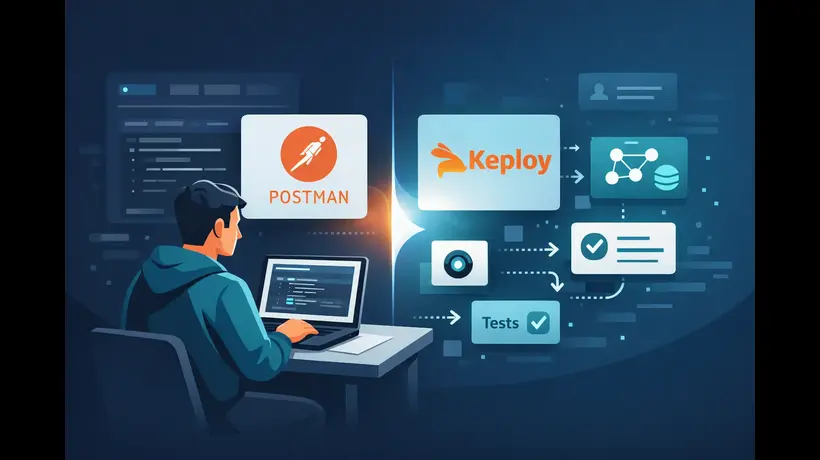
Postman has been the go-to API client for a decade. But as development workflows grow more complex and team sizes scale, many engineering teams are discovering that Postman's manual-first model creates friction — expensive plans, bloated workspaces, and test suites that need constant hand-maintenance. In 2026, there are better-fit tools for almost every use case. This guide breaks them down.
Why Teams Are Looking Beyond Postman
The most common complaints about Postman from development teams fall into a few categories. First, cost: Postman's team and enterprise tiers have become expensive, especially for large organizations. Second, maintenance burden: Postman collections are hand-written and degrade as APIs evolve. Third, CI/CD integration: while Newman enables CLI execution, the workflow still requires developers to maintain collections manually.
Top Postman Alternatives
1. Keploy — AI-Powered Automated Testing
Keploy takes a fundamentally different approach to API testing. Rather than requiring developers to write test cases manually, Keploy captures real API traffic and converts it into test cases and mocks automatically. The result is a test suite built from actual usage — not hand-crafted scenarios that may miss real-world edge cases.
Keploy's standout capability is handling dynamic data: timestamps, session tokens, and random IDs are automatically detected and excluded from assertions, eliminating the flaky tests that plague manual test suites. It integrates natively with CI/CD pipelines and supports microservices architectures through automatic dependency mocking.
Best for: Engineering teams that want high API test coverage without the overhead of maintaining a test suite manually.
2. Insomnia
Insomnia is a clean, open-source REST and GraphQL client built for developers who want Postman's core functionality without the enterprise pricing. It supports request chaining, environment variables, and plugin extensions. The learning curve is minimal, and the interface is less cluttered than Postman's.
Best for: Individual developers or small teams doing exploratory API testing and request management.
3. Bruno
Bruno is an emerging open-source API client that stores collections as plain files in a Git repository rather than in a proprietary cloud. This design choice makes collections version-controllable alongside application code — a major advantage for teams already using Git workflows.
Best for: Teams that want API collections treated as code and stored in source control.
4. Hoppscotch
Hoppscotch is a lightweight, web-based API testing tool that works in the browser with no installation. It supports REST, GraphQL, WebSocket, and SSE protocols. The self-hosted option is attractive for teams with data-sovereignty requirements.
Best for: Quick ad-hoc API exploration and teams that need a browser-based tool.
5. REST Assured
REST Assured is a Java library for writing automated API tests in code. It integrates directly with JUnit or TestNG and fits naturally into backend Java projects where the test suite lives alongside the application code.
Best for: Java backend teams who want API tests embedded in their existing test framework.
6. Karate DSL
Karate combines API testing, mocking, and performance testing in a single framework using a human-readable DSL. It requires no coding experience to write basic tests, making it accessible to QA professionals who are not software engineers.
Best for: QA teams that want a unified framework covering functional and performance testing.
How to Choose the Right Tool
The right Postman alternative depends on your team's specific needs. If you write tests manually and need better collaboration, Bruno or Insomnia are natural fits. If you want to stop writing tests manually altogether, Keploy's traffic-capture approach is the most significant improvement. If your team is Java-first, REST Assured belongs in your stack. If you need a no-install option for quick testing, Hoppscotch delivers.
Conclusion
Postman pioneered the category, but it is no longer the only serious option. Modern API testing demands tools that integrate with CI/CD, reduce maintenance overhead, and scale with team complexity. Evaluate the alternatives above against your team's actual workflow — you may find that switching saves both time and cost.

 Arabic
 French
 Spanish
 Portuguese
 Deutsch
 Turkish
 Dutch
Dutch
 Italiano
 Russian
 Romaian
 Portuguese (Brazil)
 Greek
Greek