

Custom-Software-Development-ROI-vs-Saas-ROI
Why ROI Comparison Matters More Than Ever
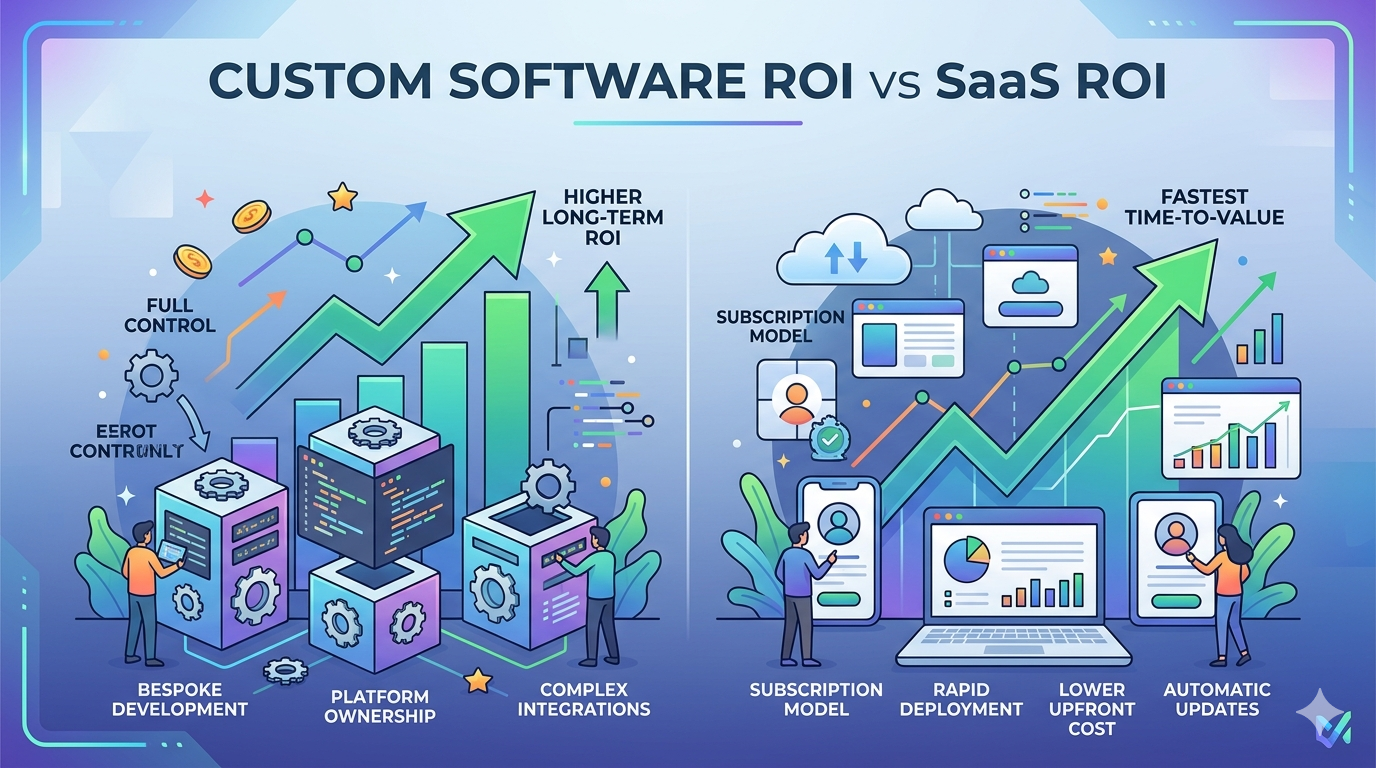
When businesses compare custom software development and SaaS tools, the conversation usually starts with cost. But cost alone does not define return on investment. ROI is about what you gain over time efficiency, scalability, control, competitive advantage, and long‑term savings.
In 2026, this comparison matters even more because businesses are no longer choosing software just to “run operations.” They’re choosing platforms that power automation, AI workflows, and decision‑making. Understanding the difference between custom software development ROI and SaaS ROI helps founders, CTOs, and decision‑makers avoid short‑term thinking that leads to long‑term limitations.
What ROI Really Means in Software Decisions
ROI in software is not immediate profit. It is the net value created over time after accounting for costs, risks, and opportunity loss.
For SaaS, ROI often comes from:
- Fast setup
- Predictable monthly pricing
- Minimal upfront investment
For custom software, ROI is driven by:
- Workflow efficiency
- Elimination of manual labor
- Reduced dependency on multiple tools
- Long‑term cost control
- Strategic differentiation
Both models can generate ROI but in very different ways and timelines.
SaaS ROI: Fast Returns, Built‑In Limits
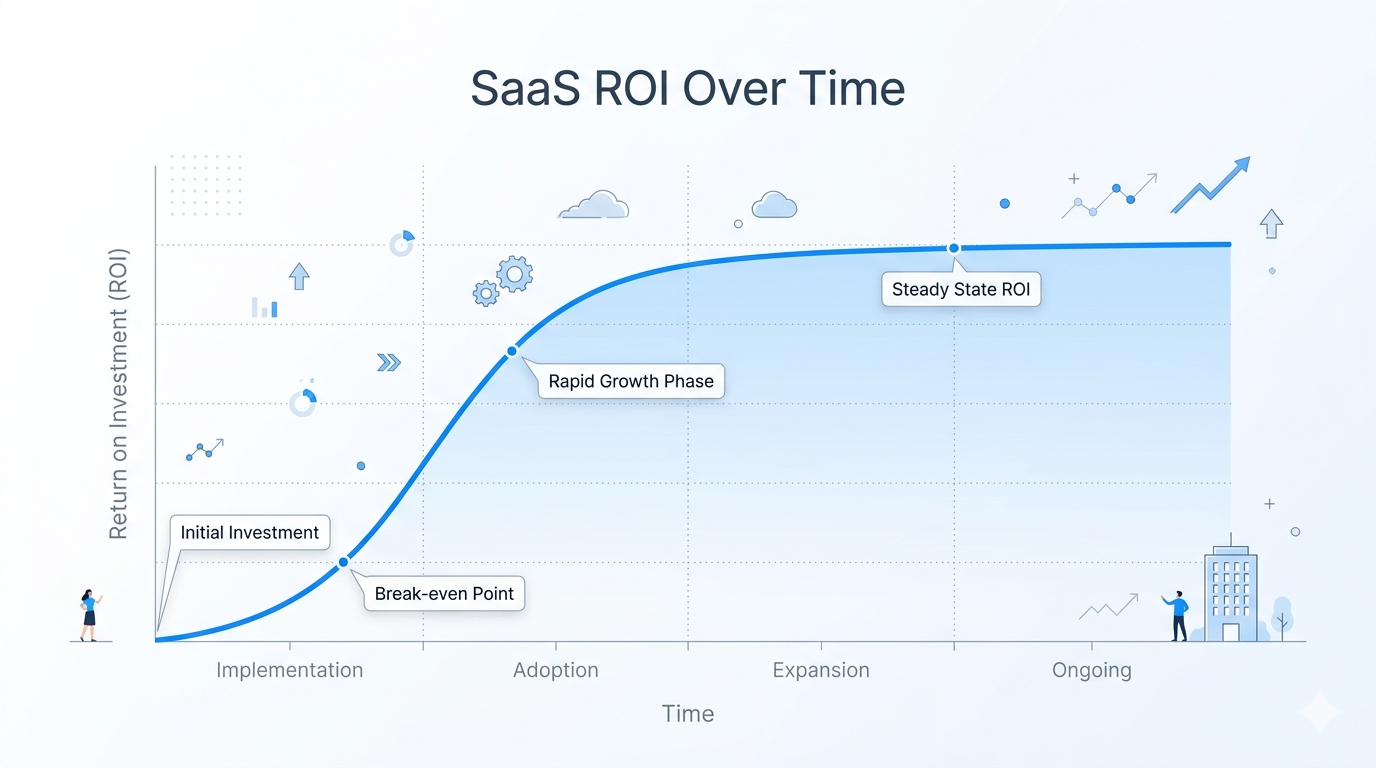
SaaS ROI is strongest in the short term. You sign up, configure settings, and start using the tool almost immediately. For startups and SMEs, this quick activation creates early wins.
SaaS delivers ROI when:
- Workflows are standard
- Processes don’t require deep customization
- Integrations are simple
- Growth is moderate
However, SaaS ROI often plateaus. As teams grow, subscription costs rise, add‑ons become necessary, and workarounds appear. At scale, businesses pay repeatedly for features they don’t use while still missing the ones they need.
Custom Software Development ROI: Slower Start, Compounding Gains
Custom software ROI starts later but grows stronger over time. Initial investment is higher because you’re building something specific to your workflows. But once deployed, custom systems eliminate inefficiencies permanently.
Custom software ROI increases when:
- Your workflow is unique
- Operations involve repeated manual steps
- Multiple SaaS tools are stitched together
- Data needs to flow across systems
- Automation and AI are part of the roadmap
Unlike SaaS, custom platforms compound ROI. Every improvement builds on your own system instead of someone else’s roadmap.
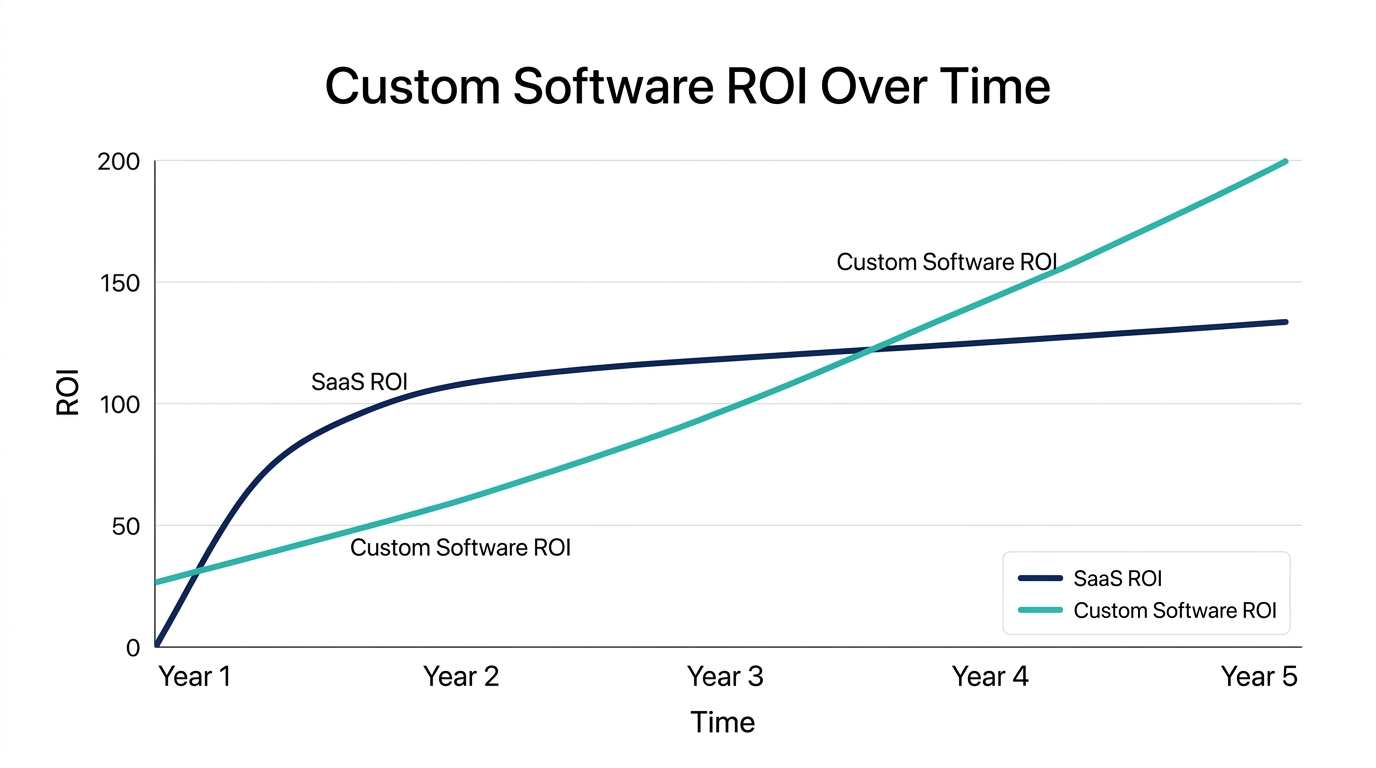
Table (Visual): ROI Comparison SaaS vs Custom Software
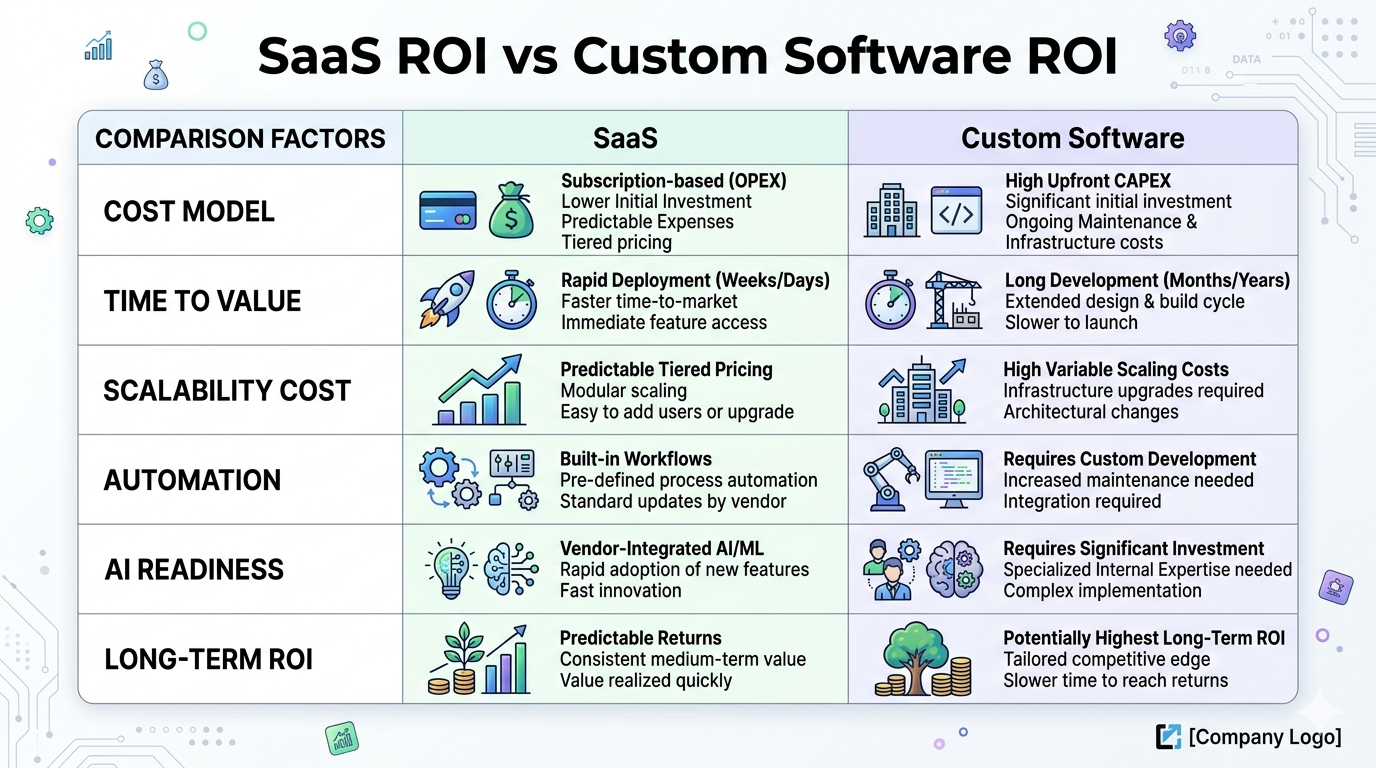
| Factor | SaaS ROI | Custom Software ROI |
|---|---|---|
| Upfront cost | Low | Higher |
| Time to value | Immediate | Gradual |
| Scalability cost | Increases with users | Mostly fixed |
| Workflow fit | Generic | Exact match |
| Automation potential | Limited | High |
| AI readiness | Restricted | Fully controllable |
| Long-term ROI | Flattens | Compounds |
The Hidden Cost Factor Most ROI Calculations Miss
Most ROI calculations ignore hidden operational costs:
- Hours wasted switching tools
- Manual data entry
- Workaround maintenance
- Training employees on multiple systems
- Subscription sprawl
These costs don’t appear on invoices, but they reduce productivity every day. Custom software ROI often becomes clear only after these hidden costs disappear.
Graph: ROI Over Time (SaaS vs Custom Software)
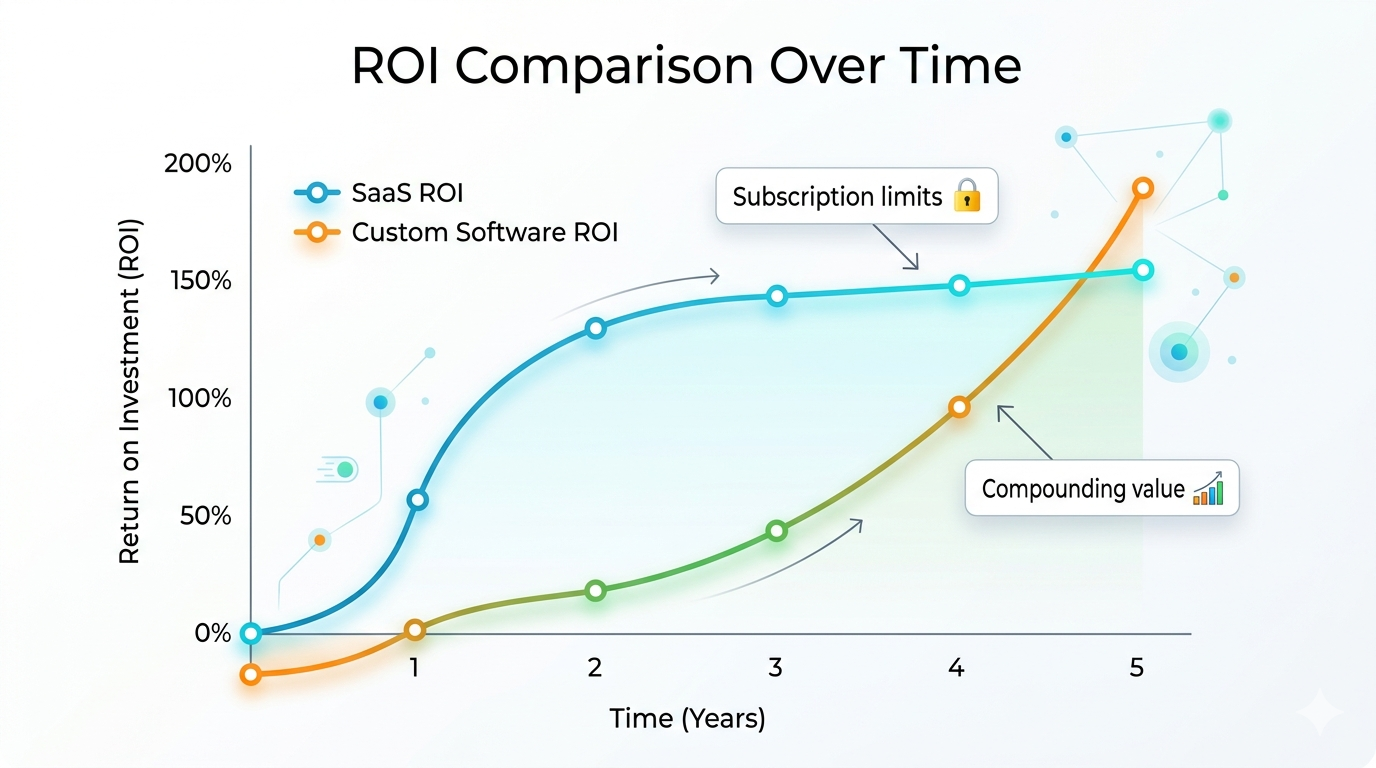
This graph visually shows:
- SaaS ROI rising quickly, then flattening
- Custom software ROI starting slower, then surpassing SaaS over time
AI and Automation: The ROI Multiplier
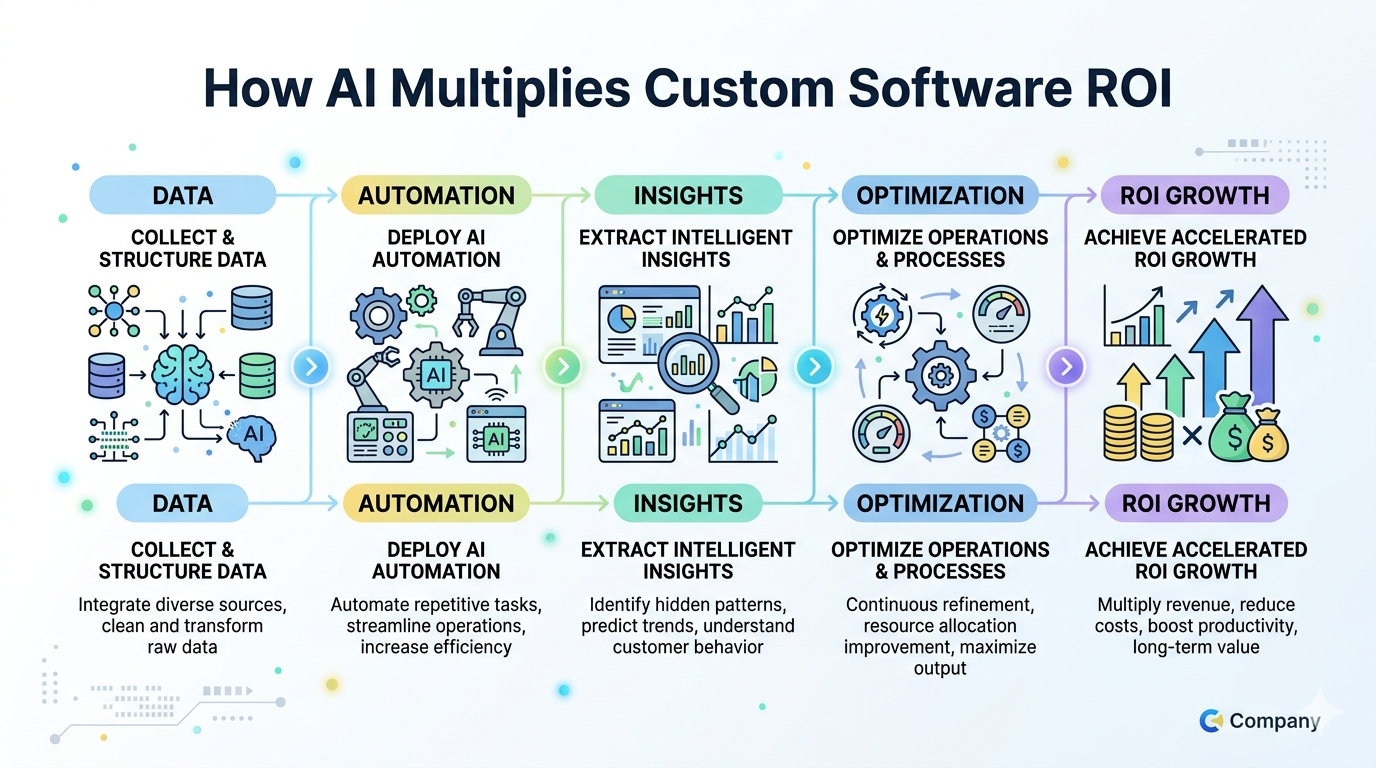
In modern systems, ROI is increasingly tied to AI readiness. SaaS tools often restrict AI usage to predefined features. You can’t control data pipelines, model logic, or optimization strategies.
With ai software development, custom platforms unlock:
- Workflow‑specific automation
- Predictive analytics
- Intelligent routing
- Internal copilots
- Secure AI integration
AI turns custom software from a cost center into a strategic asset, dramatically increasing ROI beyond what SaaS can offer.
When SaaS ROI Makes More Sense
SaaS is usually the better ROI choice when:
- You are early‑stage
- Workflows are standard
- Speed matters more than control
- Budget is extremely constrained
SaaS helps validate ideas quickly. But it should be treated as a temporary efficiency tool, not a long‑term operational backbone.
When Custom Software ROI Wins
Custom software becomes the better ROI decision when:
- Growth causes SaaS costs to spike
- Teams rely on manual processes
- Data consistency matters
- Competitive advantage depends on execution
- AI and automation are core to strategy
This is why many scaling companies migrate from SaaS to custom software development once they outgrow generic solutions.
FAQs
1. What is the main difference between custom software ROI and SaaS ROI?
The main difference is the timeline and type of return. SaaS ROI is usually faster because the tool is ready to use quickly, but it can become limited as your business grows. Custom software ROI usually takes longer to appear because it requires upfront development, but it can create stronger long-term value through automation, workflow fit, scalability, and ownership.
2. Is SaaS cheaper than custom software development?
SaaS is usually cheaper at the beginning because it has low setup costs and monthly pricing. However, costs can increase as your team grows, especially through per-user pricing, add-ons, premium features, and integration tools. Custom software development has a higher upfront cost, but it can become more cost-effective over time if it replaces multiple tools and reduces manual work.
3. When does custom software development deliver better ROI?
Custom software development delivers better ROI when your workflows are unique, your team depends on manual processes, or your business needs strong integrations across systems. It also becomes more valuable when your software supports revenue, customer experience, automation, or AI-driven decision-making. In these cases, custom software can become a long-term business asset instead of just another operating expense.
4. When is SaaS the better ROI choice?
SaaS is the better ROI choice when your needs are standard, your budget is limited, and speed matters more than customization. It works well for common functions like basic CRM, email marketing, accounting, project management, or helpdesk systems. SaaS is also a smart option when you are still validating an idea and do not yet know whether a custom solution is worth building.
5. How does AI affect software ROI?
AI can increase software ROI by automating repetitive tasks, improving decision-making, personalizing user experiences, and reducing operational delays. However, AI works best when the underlying system has clean data, clear workflows, and strong security controls. This is why AI often delivers stronger value inside custom platforms, where the business can control data, logic, workflows, and optimization.
6. How should a business decide between SaaS and custom software?
A business should compare short-term speed with long-term value. If the workflow is standard and the goal is quick implementation, SaaS is often the better choice. If the workflow is unique, integration-heavy, or central to revenue and growth, custom software is usually the stronger long-term investment. A practical approach is to use SaaS for standard needs and build custom software for strategic workflows.


 Arabic
 French
 Spanish
 Portuguese
 Deutsch
 Turkish
 Dutch
Dutch
 Italiano
 Russian
 Romaian
 Portuguese (Brazil)
 Greek
Greek