


Why DataOps is the Backbone of Scalable Data Infrastructure
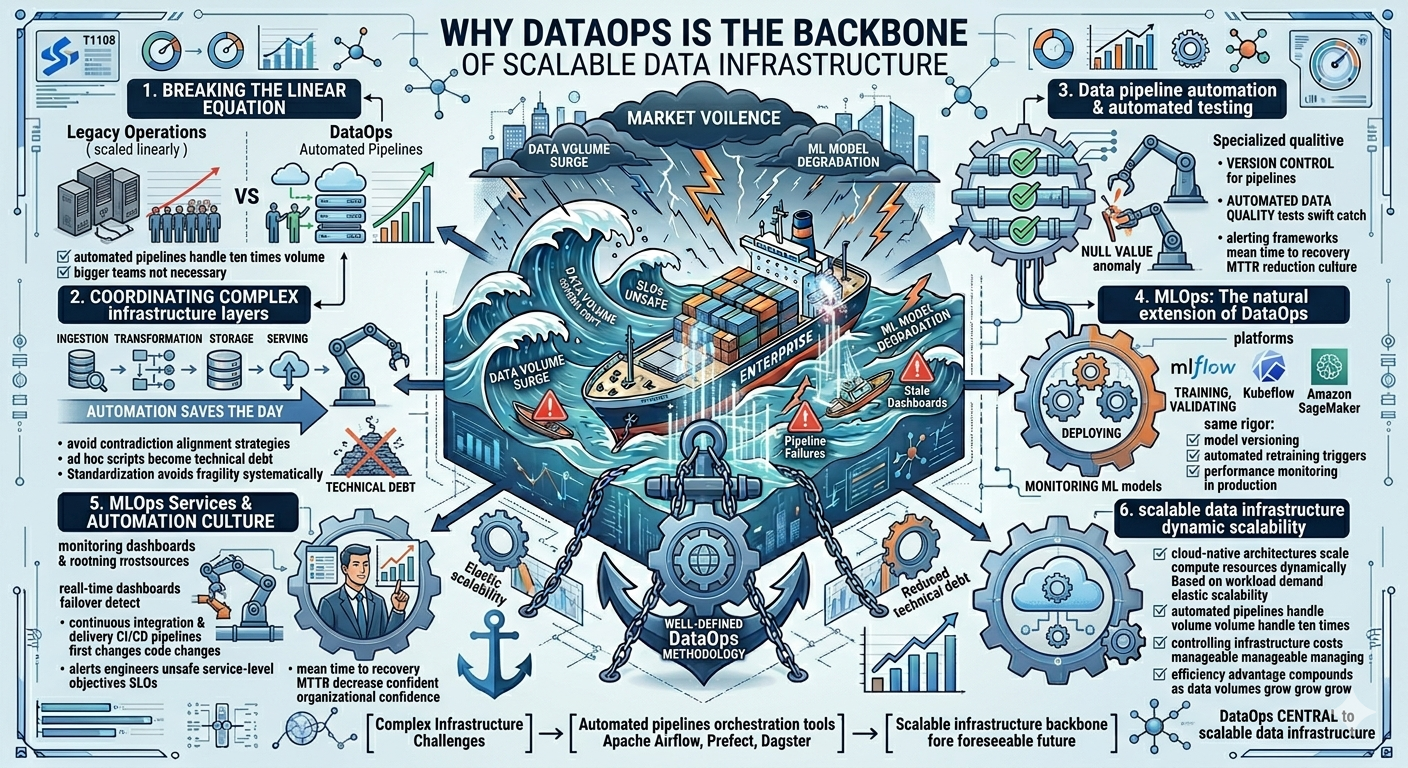
What do you think happens when data pipelines break? Yes, models just keep drifting. Nobody wants that. Additionally, dashboards go stale. By the way, none of these are hypothetical risks. They are daily realities for data teams worldwide that manage complex infrastructure.
Thankfully, DataOps has emerged as the discipline that will make solving those problems less overwhelming and more systematic. This post will argue that DataOps serves as the backbone of scalable data infrastructure for the foreseeable future.
What DataOps Actually Means
DataOps is a portmanteau for data operations. So, it is not a single tool or technology. Instead, it means a fully formed and documented methodology. Primarily, stakeholders expect DataOps to combine three major areas:
-
Agile development practices
-
Data pipeline automation
-
Cross-functional collaboration
Why do leaders want to do that? Well, they aspire to improve both data delivery speed and quality.
That is why dataops solutions will use version control for pipelines, automated testing for data quality, and monitoring dashboards to detect failures. In such ways, organizations that adopt DataOps can effectively reduce pipeline failures while accelerating delivery cycles. Besides, all those improvements will be measurable and reportable.
The Infrastructure Challenge DataOps Solves
Scalable data infrastructure necessitates significant coordination. Across ingestion, transformation, storage, and serving layers, activities must avoid contradictions. So, alignment strategies play a major role in this.
Since manual handoffs between those layers could introduce errors, automation can save the day. However, ad hoc scripts inevitably become technical debt. Thus, without standardization, infrastructure grows fragile as data volumes keep increasing.
In response, firms must deploy DataOps and address this fragility systematically. To that end, automated orchestration tools like Apache Airflow, Prefect, and Dagster will be useful. They will essentially manage pipeline dependencies. So, human intervention will be less necessary.
MLOps: The Natural Extension of DataOps
Machine learning operations (MLOps) also extend DataOps principles to the model lifecycle. Hence, training, validating, deploying, and monitoring machine learning (ML) models requires the same rigor as managing data pipelines.
That is also why MLOps services provide model versioning. They include automated retraining triggers and performance monitoring in production. So, managers and data professionals' workflows get easier.
Platforms like MLflow, Kubeflow, and Amazon SageMaker are now available. They matter a lot simply because they support end-to-end MLOps workflows. In other words, without MLOps, models degrade silently. Thus, they deliver incorrect predictions. That happens at scale and threatens reliability.
Automation as the Core of DataOps
Automation is the key to effective DataOps implementation. That means, continuous integration and continuous delivery (CI/CD) pipelines must first validate code changes. In short, do not rush into deployment.
Then, there are automated data quality checks. They swiftly catch schema drift and null value anomalies, so stakeholders can peacefully prevent them before they reach downstream consumers. Alerting frameworks also notify engineers when service-level objectives (SLOs) are unsafe.
This automation culture reduces mean time to recovery (MTTR). As a result, organizational confidence in data assets only increases.
Conclusion
Legacy data operations have scaled linearly because more data meant more engineers. How does DataOps break this equation? Its automated pipelines handle ten times the data volume. That is why bigger teams are necessary.
Similarly, cloud-native architectures scale compute resources. That happens dynamically based on workload demand. So, organizations achieve elastic scalability. At the same time, controlling infrastructure costs becomes manageable.
This efficiency advantage compounds as data volumes grow, highlighting that DataOps is central to scalable data infrastructure.
-

 Arabic
 French
 Spanish
 Portuguese
 Deutsch
 Turkish
 Dutch
Dutch
 Italiano
 Russian
 Romaian
 Portuguese (Brazil)
 Greek
Greek