


What is Labour Charge? Meaning, Types, Calculation, and Its Impact on Business Profitability
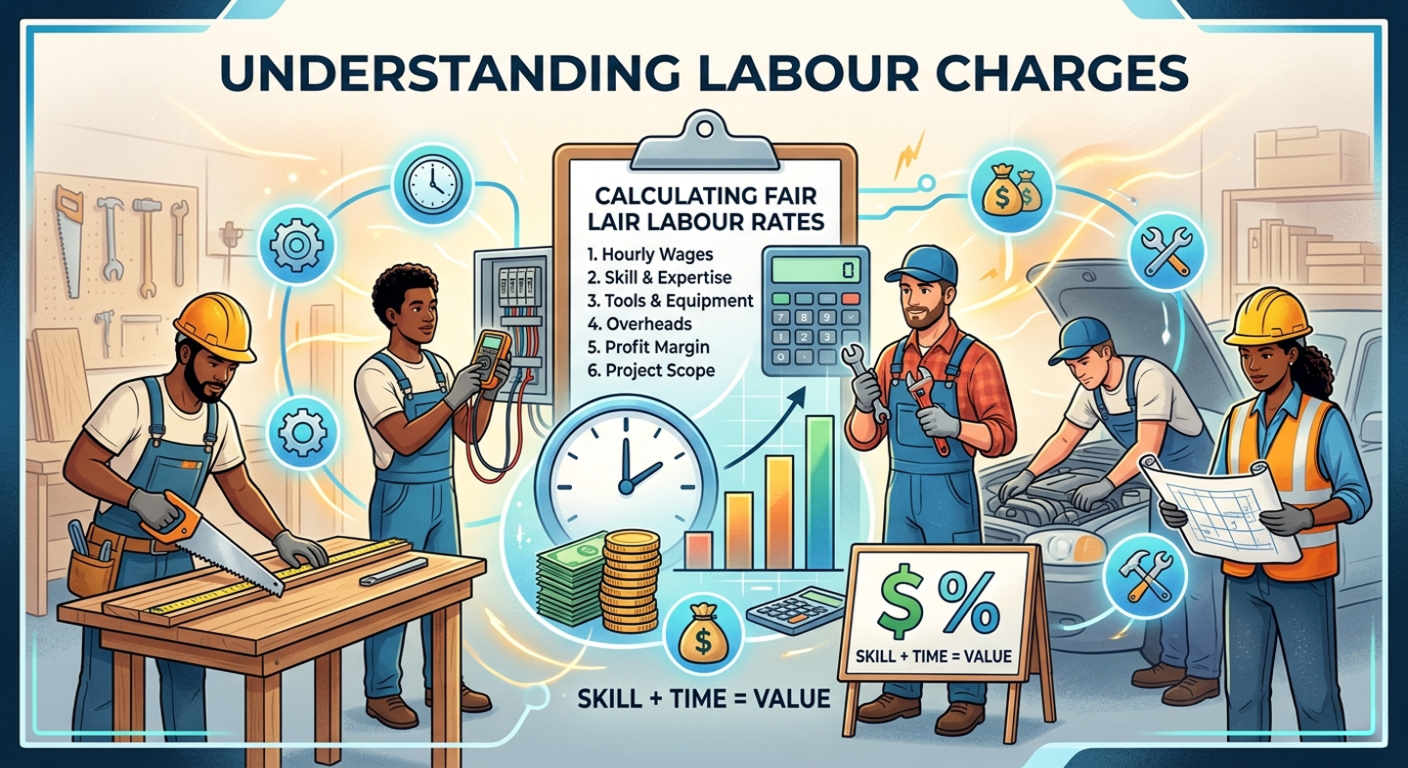
Labour cost is one of the biggest expenses for any business.
But here’s the problem…
Most businesses don’t fully understand how labour charges actually work. And that leads to poor pricing, low profits, and compliance risks.
So if you want to control costs and grow your business, you need to understand labour charges the right way.
Let’s break it down step by step.
What is Labour Charge?
Labour charge is the total amount paid to workers for the services or work they perform.
It can be calculated based on:
- Hourly wages
- Daily wages
- Monthly salaries
- Project-based payments
In simple terms:
👉 Labour charge = Cost of human effort used in a business
For example:
- A construction worker paid ₹800 per day
- A freelancer paid ₹10,000 per project
- An employee earning ₹25,000 per month
All of these are examples of labour charges.
Why Labour Charges Are Important
If you ignore labour costs, your business will suffer.
Here’s why they matter so much:
1. Direct Impact on Profit
Labour is often the largest operational expense. Even a small miscalculation can reduce your profit margins.
2. Helps in Pricing Strategy
If you don’t know your labour cost, you might:
- Underprice your services (loss)
- Overprice your services (lose customers)
3. Improves Budget Planning
Accurate labour cost estimation helps you plan:
- Hiring
- Expansion
- Project budgets
4. Ensures Legal Compliance
Incorrect wage calculations can lead to:
- Penalties
- Legal disputes
- Employee dissatisfaction
Types of Labour Charges
To understand labour costs better, you need to divide them into categories.
Direct Labour Charges
These are costs for workers who are directly involved in production or service delivery.
Examples:
- Factory workers
- Technicians
- Delivery personnel
- Machine operators
👉 These costs directly affect output and productivity.
Indirect Labour Charges
These are costs for employees who support business operations but are not directly involved in production.
Examples:
- HR staff
- Admin team
- Security guards
- Maintenance staff
👉 These costs are essential but don’t directly generate revenue.
Components of Labour Charges (Hidden Costs You Shouldn’t Ignore)
Most people think labour cost = salary.
That’s not true.
Here’s what actually goes into labour charges:
- Basic salary or wages
- Overtime payments
- Bonuses and incentives
- Paid leaves
- Employer contributions (PF, ESI, etc.)
- Insurance and benefits
- Training costs
- Recruitment expenses
👉 These hidden costs can increase total labour expenses by 20-40%.
How to Calculate Labour Charges
Let’s keep it simple.
Basic Formula:
Labour Charge = Wages + Benefits + Overtime + Employer Contributions
Example Calculation:
Let’s say you have an employee with:
- Basic Salary: ₹18,000
- Overtime: ₹2,000
- Benefits: ₹3,000
- Employer Contributions: ₹2,000
👉 Total Labour Charge = ₹25,000
Cost Per Hour Formula:
If you want deeper insights:
Labour Cost per Hour = Total Labour Cost ÷ Total Working Hours
This helps in:
- Project costing
- Client billing
- Productivity tracking
Factors That Affect Labour Charges
Labour costs are not fixed. They change based on multiple factors:
1. Skill Level
Highly skilled workers demand higher wages.
2. Industry Type
IT, healthcare, and manufacturing all have different labour structures.
3. Location
Urban areas usually have higher labour costs than rural areas.
4. Demand and Supply
If skilled workers are scarce, costs go up.
5. Government Regulations
Minimum wages, PF, ESI, and labour laws impact overall cost.
6. Working Hours and Overtime
More overtime = higher labour expense.
Labour Charges in Different Industries
Labour cost structure varies across industries:
Construction
- Mostly daily wage workers
- High dependency on contract labour
Manufacturing
- Combination of direct and indirect labour
- Focus on productivity and efficiency
IT and Services
- Salary-based workforce
- Higher indirect labour costs
Retail
- Mix of full-time and part-time employees
- High employee turnover
Common Mistakes Businesses Make
Many businesses lose money due to poor labour cost management.
Here are some common mistakes:
- Ignoring indirect labour costs
- Not tracking overtime properly
- Manual payroll errors
- Underestimating compliance costs
- Overstaffing or understaffing
- Not analyzing productivity
👉 Fixing these mistakes can instantly improve your margins.
How to Reduce and Control Labour Charges
You don’t need to cut salaries to reduce costs.
Instead, focus on smarter management.
1. Automate Payroll and Attendance
Reduces errors and saves time.
2. Track Employee Productivity
Identify high-performing and low-performing employees.
3. Optimize Workforce Planning
Hire based on actual business needs.
4. Control Overtime
Plan shifts efficiently to avoid unnecessary overtime.
5. Train Employees
Skilled employees work faster and reduce overall cost.
6. Stay Compliant
Avoid penalties and legal issues.
Labour Charges vs Labour Cost: Is There a Difference?
Yes, there is a slight difference.
- Labour Charge → Amount paid for specific work or service
- Labour Cost → Total expense incurred on workforce
👉 Labour cost is broader and includes indirect expenses.
The Role of Technology in Managing Labour Charges
Modern businesses are moving away from manual processes.
Using digital tools helps in:
- Accurate payroll processing
- Real-time attendance tracking
- Compliance management
- Cost analysis
This leads to better decision-making and cost control.
Final Thoughts
Labour charges are not just an expense, they are a key driver of business success.
If managed well, they can:
- Improve profitability
- Increase efficiency
- Help in better decision-making
But if ignored, they can quickly become a financial burden.
👉 The goal is simple:
Understand your labour cost, track it regularly, and optimize it smartly.

 Arabic
 French
 Spanish
 Portuguese
 Deutsch
 Turkish
 Dutch
Dutch
 Italiano
 Russian
 Romaian
 Portuguese (Brazil)
 Greek
Greek