


How Container Freight Stations (CFS) Work in Export Handling
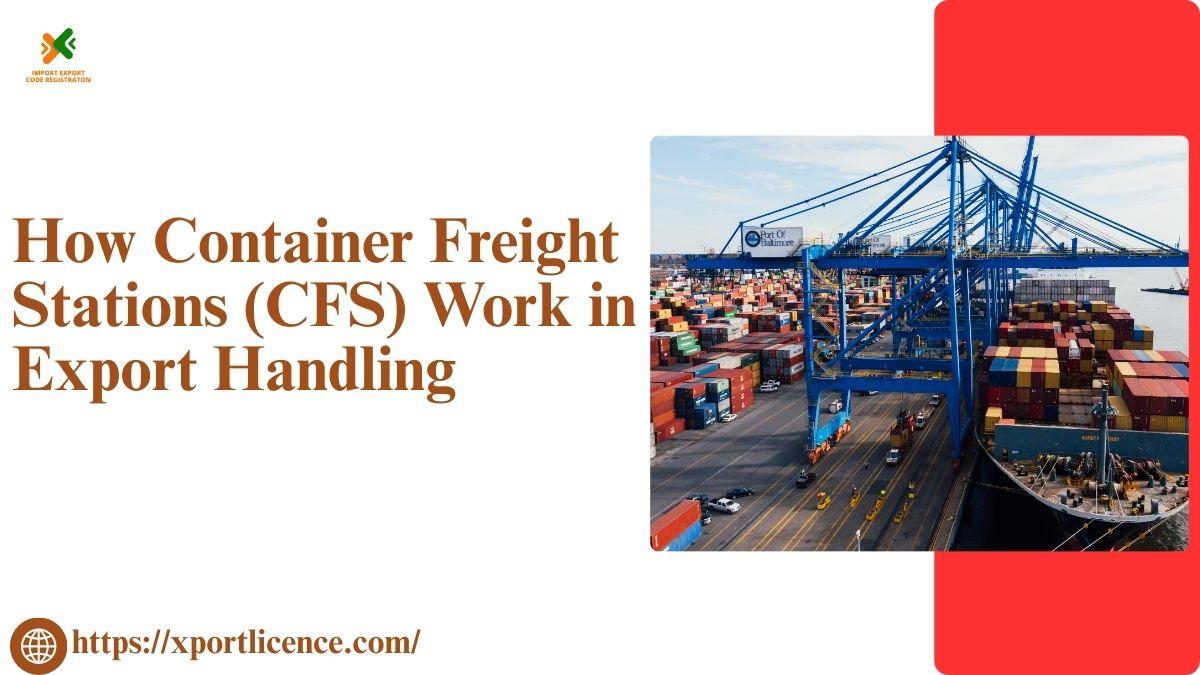
Exporting goods from India involves several important steps that happen before the shipment reaches the seaport. Many new exporters believe that once they pack their goods and send them to the port, the shipment is ready to sail. But in reality, most export cargo first goes through a facility known as a Container Freight Station (CFS), where customs checks, documentation, cargo consolidation, and container stuffing take place.
Before any shipment can move to a CFS, every exporter must have a valid Import Export Code (IEC). Without IEC, no export business can legally ship goods from India. Understanding how a CFS works is extremely important for new exporters because it directly affects time, cost, paperwork, and cargo safety. And in this blog, we will explain this part clearly so that even beginners can confidently handle export shipments without confusion.
What Is a Container Freight Station (CFS)?
A Container Freight Station (CFS) is a customs-controlled facility located near a seaport or an Inland Container Depot (ICD). It acts as a processing point where export cargo is received, inspected, documented, and loaded into containers before being sent to the port terminal.
Think of CFS as a “pre-port hub” where all the export formalities happen smoothly before the cargo reaches the main port for loading onto the vessel.
Why Is a CFS Important in Export Handling?
A CFS plays a key role in ensuring that export cargo is:
-
Properly documented
-
Cleared by customs
-
Safely packed inside containers
-
Consolidated with other shipments (in case of LCL)
-
Delivered to the port on time
How Does the Export Process Work Inside a CFS?
Here is a clear step-by-step explanation in simple language:
1. Cargo Arrival at the CFS
Exporters send goods from their factory or warehouse to the CFS using trucks. At the gate, security checks the vehicle, shipment papers, and entry details. The cargo is unloaded and stored in a designated area.
2. Cargo Verification
CFS staff verify:
-
Number of packages
-
Weight
-
Shipping marks
-
Packaging condition
3. Document Submission
Exporters—or their CHA (Custom House Agent)—submit documents such as:
-
Shipping Bill
-
Commercial Invoice
-
Packing List
-
Buyer order copy
-
Transport documents
4. Customs Inspection
A customs officer examines the goods based on the Shipping Bill. Depending on the risk category:
-
Some shipments undergo physical inspection
-
Some are checked through scanning
-
Some are cleared based on documents
5. Container Stuffing
Once customs allows the shipment, the cargo is moved to the stuffing area.
There are two types of stuffing:
-
Factory Stuffing – container is sealed at the exporter’s factory
-
CFS Stuffing – container is sealed at the CFS
6. Container Sealing
After stuffing, customs affixes a bottle seal or electronic seal (e-seal). This ensures the container is not opened during the journey.
7. Container Movement to Port
CFS arranges transportation to the port terminal. The sealed container is handed over to the shipping line, ready to be loaded on the vessel.
Role of a CFS in Different Shipping Methods
1. In FCL (Full Container Load)
For exporters who handle larger shipments or plan to scale their export business, the CFS plays a crucial role. The CFS provides:
-
Empty container pickup
-
Stuffing supervision
-
Weight measurement
-
Customs clearance
-
Sealing and transport to port
2. In LCL (Less than Container Load)
A CFS becomes even more important in LCL because it helps small and medium exporters ship goods without booking a full container. This method is often preferred by growing export business owners who send small volumes. Here, the CFS:
-
Consolidates cargo from multiple exporters
-
Creates a single LCL container
-
Issues HBL through the freight forwarder
Difference Between CFS and ICD
Many exporters confuse the two. Here is the simple difference:
CFS (Container Freight Station)
-
Located near sea ports
-
Handles cargo before it reaches the vessel
-
Main role: stuffing, customs clearance, consolidation
ICD (Inland Container Depot)
-
Located in cities away from ports
-
Acts like an inland port
-
Customs clearance happens here
-
Containers move sealed from ICD directly to the port
Benefits of CFS for Exporters
Here are the main advantages:
1. Faster Customs Clearance
CFS reduces congestion at ports, resulting in faster cargo processing.
2. Safe Cargo Handling
Trained staff and specialized equipment ensure packages are handled safely.
3. Ideal for Small Exporters
LCL cargo consolidation helps small businesses send small shipments cost-effectively.
4. Organized Storage Space
Goods are stored in warehouses, preventing damage or misplacement.
5. Efficient Documentation Support
CHAs and shipping line offices at the CFS help exporters complete documents easily.
6. Reduced Port Rush and Delays
Ports stay focused on loading and unloading vessels while CFS handles all ground operations.
Why New Exporters Must Understand CFS Operations
Most shipment delays happen because exporters do not understand where their cargo goes, what documents are required, or how customs checks work. Knowing how CFS functions helps exporters:
-
Plan dispatch timelines
-
Calculate correct logistics costs
-
Manage packaging and labeling accurately
-
Coordinate better with freight forwarders or CHA
-
Avoid unnecessary penalties or storage charges
Conclusion
Container Freight Stations (CFS) are the backbone of export logistics in India. They ensure safe cargo handling, smooth customs clearance, proper stuffing, and timely movement of containers to the port. For new exporters, understanding CFS operations helps reduce delays, manage costs, and maintain a smooth export workflow.
Note: For more export documentation and licensing support, visit: https://xportlicence.com/ .

 Arabic
 French
 Spanish
 Portuguese
 Deutsch
 Turkish
 Dutch
Dutch
 Italiano
 Russian
 Romaian
 Portuguese (Brazil)
 Greek
Greek