


CIS Tax Method

CIS Tax Method Explained: How HMRC Calculates and Applies Deductions in the Construction Industry
The CIS tax method is one of the most practical yet frequently misunderstood parts of the UK tax system. In everyday practice, I regularly encounter subcontractors who believe CIS deductions are their final tax bill and contractors who unknowingly apply incorrect deduction rates. These misunderstandings often surface only when HMRC raises queries or penalties.
The Construction Industry Scheme is not a separate tax regime. It is a method of collecting income tax in advance, aimed specifically at construction-related work. Once that distinction is clear, the logic behind the CIS tax method becomes far easier to follow.
How the CIS Tax Method Fits Into the UK Tax System
The CIS tax method works alongside existing UK tax obligations rather than replacing them. HMRC uses CIS as a withholding mechanism, ensuring that tax is collected throughout the year from subcontractors who are paid gross amounts for their work.
For most subcontractors, CIS interacts directly with:
- Self-Assessment income tax
- Class 2 and Class 4 National Insurance
- Corporation tax for limited companies
CIS deductions made during the year are credited to the subcontractor’s HMRC record. These amounts are then offset against the final tax liability once the annual return is filed. This explains why many subcontractors receive refunds, while others still owe tax despite CIS deductions.
Who Does the CIS Tax Method Apply To in Practice
CIS applies when construction work is carried out in the UK, and one party is classed as a contractor under HMRC rules.
Subcontractors commonly affected include:
- Tradespeople such as electricians, plumbers, bricklayers, and plasterers
- Groundworkers and labour-only subcontractors
- Scaffolders, roofers, and steel fixers
- Construction limited companies
Less obvious cases arise with:
- Property developers
- Landlords exceeding HMRC’s construction spending threshold
- Businesses commissioning construction work as part of a wider operation
In practice, failure to recognise contractor status early often leads to retrospective registration, penalties, and interest.
CIS Deduction Rates and How They Are Applied
The CIS tax method is built around three fixed deduction rates. These rates are applied only to the labor element of a subcontractor’s invoice.
|
Subcontractor status |
Deduction rate |
Practical impact |
|
Registered and verified |
20% |
Standard CIS deduction |
|
Not registered |
30% |
Higher-rate deduction |
|
Gross payment status |
0% |
Paid in full |
The 30% deduction rate is effectively a penalty rate. In real terms, it often causes severe cash flow strain and can take years to recover through refunds.
What the CIS Tax Method Is Calculated On
CIS deductions apply strictly to labor costs. This distinction is critical and frequently overlooked.
Included in CIS calculations:
- Labor charges
- Supervisory labor
- Certain labor-related overheads
Excluded from CIS calculations:
- Materials (must be clearly itemised)
- VAT is charged on the invoice
- Equipment hire without labor
- Fuel is charged for material delivery
Invoices that are poorly structured often result in excessive deductions. Contractors are entitled to deduct CIS on the full amount, excluding VAT, if labor and materials are not clearly separated.
Practical Example of the CIS Tax Method in Use
A registered subcontractor submits the following invoice:
Labor: £3,000
Materials: £1,200
VAT at 20%: £840
Total invoice: £5,040
CIS applies only to labor.
CIS deduction at 20% of £3,000 = £600
Net payment to subcontractor:
£5,040 – £600 = £4,440
The contractor pays the £600 directly to HMRC and reports it on the monthly CIS return.
Contractor Responsibilities under the CIS Tax Method
From a contractor’s perspective, CIS is administered monthly, not annually.
Key obligations include:
- Registering for CIS
- Verifying subcontractors before payment
- Calculating deductions accurately
- Submitting monthly CIS returns
- Paying deductions to HMRC by the statutory deadline
- Issuing deduction statements to subcontractors
Failure to submit a return, even where no payments were made, triggers automatic penalties.
Gross Payment Status and How It Affects the CIS Tax Method
Gross payment status allows subcontractors to be paid without CIS deductions, but it does not reduce the overall tax due.
To qualify, subcontractors must:
- Operate a genuine construction business
- Meet HMRC turnover thresholds
- Maintain a strong compliance history
- File all tax returns on time
- Pay all tax liabilities promptly
Loss of gross status usually follows late filings or unpaid taxes. Reinstatement is not automatic and often takes years of perfect compliance.
How Subcontractors Reclaim CIS Deductions
The CIS tax method only balances once the annual tax return is submitted.
For sole traders:
- CIS deductions offset income tax and Class 4 NIC
- Class 2 NIC remains payable
- Excess deductions are refunded
For limited companies:
- CIS deductions can be offset against PAYE liabilities
- Remaining credits may be used against corporation tax
- Refunds depend on accurate reconciliation
Missing or incorrect CIS statements are one of the most common causes of delayed refunds.
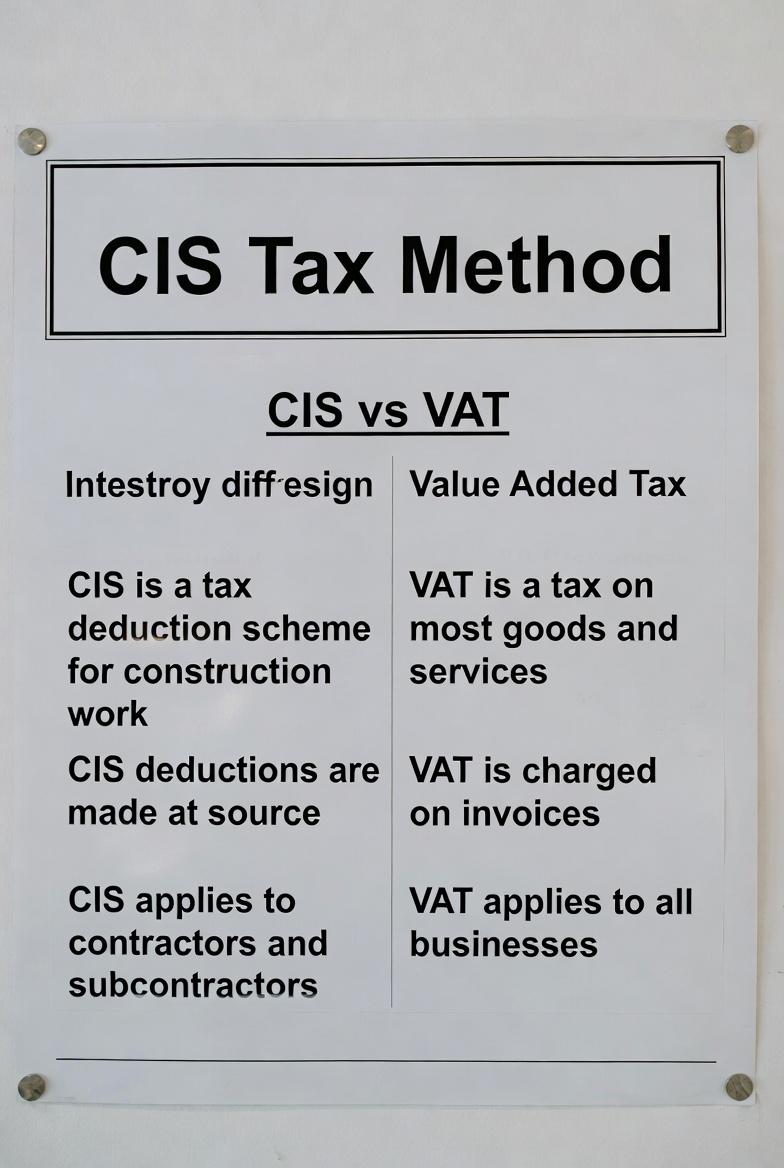
CIS and VAT: A Common Source of Confusion
CIS deductions are calculated before VAT, but VAT itself must still be accounted for correctly.
Under the VAT reverse charge for construction services:
- VAT is not paid to the subcontractor
- CIS deductions still apply to labor
- Cash flow pressure increases significantly
This interaction makes planning essential, particularly for growing subcontractors.
HMRC Compliance Checks and the CIS Tax Method
HMRC monitors CIS closely using automated data matching.
Triggers for reviews often include:
- High material claims
- Repeated late CIS returns
- Discrepancies between CIS and Self-Assessment
- Low profits reported by gross status holders
HMRC typically requests invoices, contracts, bank statements, and verification records. Well-maintained records usually lead to quick resolution.
Common CIS Tax Method Errors Seen in Practice
Most CIS problems stem from assumptions rather than complexity.
Frequent issues include:
- Treating CIS as final tax
- Failing to register on time
- Incorrect labor-to-material splits
- Applying CIS to VAT
- Ignoring Self-Assessment deadlines
- Poor record keeping
Each of these errors can result in unnecessary taxes, penalties, or delayed refunds.
Practical Advice from Long-Term CIS Experience
The CIS tax method works effectively when treated as an administrative process rather than a tax planning tool. Clear invoicing, accurate records, and timely submissions reduce risk far more than reactive fixes.
Handled properly, CIS becomes predictable. Handled casually, it quickly becomes one of the most disruptive compliance issues in the construction sector.
To get more information regarding this topic, visit Pro Tax Accountant, which is also located in London.

 Arabic
 French
 Spanish
 Portuguese
 Deutsch
 Turkish
 Dutch
Dutch
 Italiano
 Russian
 Romaian
 Portuguese (Brazil)
 Greek
Greek