


Business Analytics Certification Explained: Jobs, Skills & ROI
Business Analytics Certification is a professional credential designed to validate your ability to analyze data, interpret insights, and support better business decisions. In today’s data-saturated job market, many professionals feel a growing anxiety: Which skills will still matter in 3–5 years? Which certifications actually lead to jobs—not just certificates?
This is where business analytics certifications bring clarity.
Companies no longer hire purely on degrees. They hire for decision-making ability backed by data. Those who understand business analytics early gain a competitive advantage in interviews, promotions, and career transitions. Those who ignore it often fall behind quietly—until growth stalls or roles become obsolete. This guide explains everything you need to know, in simple terms, so you can make an informed career decision.
What Is Business Analytics Certification?
A Business Analytics Certification is a structured program that teaches you how to use data to solve business problems and support strategic decisions. It focuses on transforming raw data into insights that leaders, managers, and stakeholders can act upon.
Well-known global bodies such as IABAC (International Association of Business Analytics Certification) play a key role in standardizing business analytics skills. IABAC certifications are designed to align analytics learning with real business decision-making rather than academic theory, which is why they are widely recognized by employers.
Unlike purely technical programs, business analytics operates at the intersection of:
A Business Analytics Certification is a structured program that teaches you how to use data to solve business problems and support strategic decisions. It focuses on transforming raw data into insights that leaders, managers, and stakeholders can act upon.
Unlike purely technical programs, business analytics operates at the intersection of:
-
Data analysis
-
Business understanding
-
Strategic thinking
You don’t just learn how to analyze data, you learn why the analysis matters and how it influences revenue, cost, growth, and customer outcomes. This balance is what makes business analytics especially valuable in real-world roles.
Why Business Analytics Skills Are in High Demand
Demand for business analytics skills continues to rise across industries, not because companies love data, but because they need better decisions.
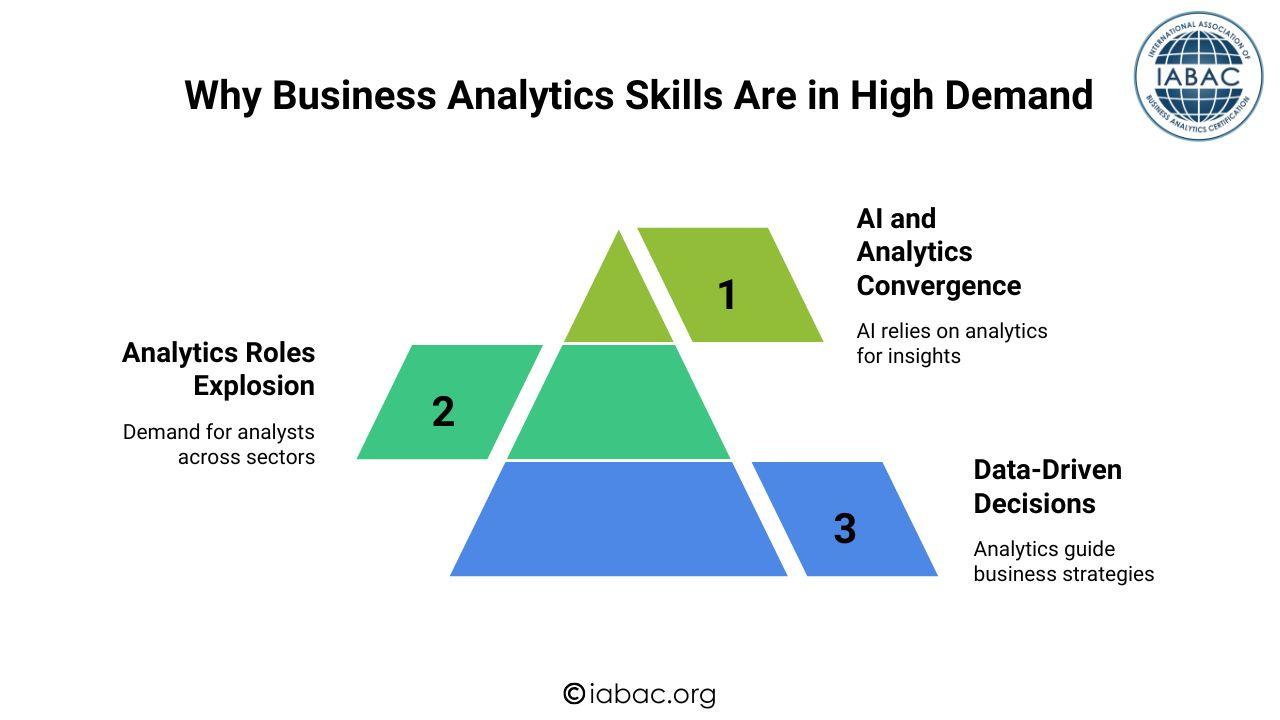
1. Business Decisions Are Now Data-Driven
Organizations use analytics to guide pricing strategies, marketing spend, inventory planning, customer retention, and risk management. Leaders expect analysts to answer questions like:
-
What is happening?
-
Why is it happening?
-
What should we do next?
Professionals who can translate data into decisions are far more valuable than those who only generate reports.
2. Explosion of Analytics-Focused Roles
Job titles such as Business Analyst, Product Analyst, Operations Analyst, and Strategy Analyst now exist in almost every sector technology, finance, healthcare, consulting, retail, and manufacturing. Analytics is no longer a niche skill; it’s a core business function.
3. AI + Analytics Are Converging
AI tools rely on high-quality data, clear metrics, and business context. Business analytics professionals play a critical role in defining KPIs, validating outputs, and ensuring AI insights align with business goals. This makes analytics roles more resilient in an AI-driven future.
Who Should Take a Business Analytics Certification?
A business analytics certification is designed for multiple career paths and experience levels.
Students & Fresh Graduates
-
Want job-ready skills beyond academic theory
-
Need exposure to real business problems and datasets
-
Looking to enter analyst roles faster
Working Professionals
-
Managers who want to make data-backed decisions
-
Professionals aiming for promotion or role expansion
-
Marketing, finance, operations, and consulting professionals upgrading their skill set
Career Switchers
-
Non-technical professionals transitioning into analytics
-
Individuals leaving stagnant or declining roles
-
Professionals seeking stable, high-growth career options
Who this may not be for:
If your primary goal is advanced machine learning research or heavy programming, a data science–focused path may be more suitable.
Skills You Gain from a Business Analytics Certification
A strong business analytics course focuses on practical, workplace-relevant skills.
Technical & Tool-Based Skills
-
Data analysis using Excel and spreadsheets
-
SQL for querying and manipulating business databases
-
Data visualization using dashboards and charts
-
Introductory Python or R (in some certifications)
Business & Analytical Skills
-
Business intelligence and reporting
-
KPI design and performance tracking
-
Problem framing and hypothesis-driven analysis
-
Communicating insights to non-technical stakeholders
These skills mirror what employers expect from analytics professionals on day one.
Career Opportunities After Business Analytics Certification
Business analytics certification opens doors to multiple career paths depending on your background and experience.
Common Job Roles
-
Business Analyst
-
Data Analyst
-
Product Analyst
-
Operations Analyst
-
Strategy or Consulting Analyst
What These Roles Actually Do
-
Analyze performance metrics and trends
-
Build dashboards for leadership teams
-
Support product and business strategy decisions
-
Identify inefficiencies and growth opportunities
Salary Ranges (Approximate)
-
Entry-level roles: $60,000 – $80,000 per year
-
Mid-level roles: $85,000 – $110,000 per year
-
Senior analytics roles: $120,000+ per year
Compensation varies by geography and industry, but analytics-certified professionals consistently earn above-average salaries.
How to Choose the Right Business Analytics Certification
This is where many learners make costly mistakes.
Look for Industry-Recognized Bodies
Not all certifications carry equal market value. Certifications aligned with global standards, such as the IABAC business analytics certification, are often preferred because they emphasize applied skills, frameworks, and real-world business scenarios.
Key Factors to Evaluate
-
Curriculum aligned with real business use cases
-
Hands-on projects using real-world datasets
-
Strong coverage of SQL, Excel, and visualization
-
Alignment with globally recognized bodies like IABAC
-
Career guidance or job alignment support
Red Flags to Avoid
-
Overly theoretical or academic programs
-
Certifications with no applied projects
-
Tool-only courses that ignore business context
The best analytics certification balances tools, thinking, and business impact.
This is where many learners make costly mistakes.
Key Factors to Evaluate
-
Curriculum aligned with real business use cases
-
Hands-on projects using real-world datasets
-
Strong coverage of SQL, Excel, and visualization
-
Career guidance or job alignment support
Red Flags to Avoid
-
Overly theoretical or academic programs
-
Certifications with no applied projects
-
Tool-only courses that ignore business context
The best analytics certification balances tools, thinking, and business impact.
Business Analytics Certification vs Data Analytics Certification
Although often used interchangeably, these certifications serve different career goals.
|
Aspect |
Business Analytics Certification |
Data Analytics Certification |
|
Core Focus |
Business decision-making |
Technical data processing |
|
Skill Emphasis |
BI, SQL, visualization, strategy |
Programming, statistics |
|
Audience |
Business & management-oriented roles |
Technical analyst roles |
|
Career Outcome |
Actionable insights & recommendations |
Analytical models & outputs |
If your goal involves leadership, consulting, product, or strategy roles, business analytics is often the better choice.
Real-World Examples: How Business Analytics Is Used in Practice
Understanding concepts is easier when you see how business analytics works in real situations.
Example 1: Marketing Optimization
A retail company notices declining online sales. A business analyst uses customer data, campaign metrics, and conversion rates to identify which channels underperform. By reallocating budget based on analytics insights, the company improves ROI without increasing spend.
Example 2: Product Decision-Making
A product analyst analyzes user behavior data to discover features that cause drop-offs. The insights guide product changes, increasing user retention and lifetime value.
Example 3: Operations Efficiency
An operations analyst studies supply chain data and identifies bottlenecks. Data-driven process changes reduce delivery delays and operating costs.
These examples highlight why companies value professionals who can connect data directly to outcomes.
Cost, Duration, and Learning Formats
Understanding the investment required helps set realistic expectations.
Cost of Business Analytics Certification
-
Online certifications: $500 – $3,000
-
University-backed programs: $3,000 – $10,000+
Cost often reflects depth, mentorship, and career support.
Duration
-
Accelerated programs: 8–12 weeks
-
Standard programs: 3–6 months
-
Part-time professional tracks: 6–9 months
Learning Formats
-
Self-paced online learning
-
Live instructor-led sessions
-
Hybrid or cohort-based programs
Choose a format that matches your schedule and learning style.
ROI: Is Business Analytics Certification Worth the Investment?
Return on investment is a major concern for professionals.
Certifications aligned with international standards, such as IABAC-certified business analytics programs, often deliver stronger ROI because employers recognize the skill framework and role readiness they represent.
Short-Term ROI
-
Improved interview performance
-
Better job alignment
-
Higher confidence with data
Long-Term ROI
-
Faster promotions
-
Role transitions into higher-paying positions
-
Greater career resilience
For many professionals, especially those completing an IABAC-aligned business analytics certification, the investment pays for itself within the first year of role transition or promotion.
Return on investment is a major concern for professionals.
Short-Term ROI
-
Improved interview performance
-
Better job alignment
-
Higher confidence with data
Long-Term ROI
-
Faster promotions
-
Role transitions into higher-paying positions
-
Greater career resilience
For many professionals, analytics certification pays for itself within the first year of role transition or promotion.
Business Analytics Certification for Different Industries
Business analytics skills are transferable across sectors.
Technology & SaaS
Focus on product metrics, user behavior, and growth analytics.
Finance & Banking
Used for risk analysis, forecasting, and performance tracking.
Healthcare
Supports patient outcomes, operational efficiency, and cost control.
Retail & E-commerce
Drives pricing, inventory planning, and customer insights.
This versatility is a key reason analytics careers remain stable.
FAQs
Do employers really value analytics certifications?
Yes, especially when paired with projects and practical skills.
Is business analytics better than an MBA?
For analytics-focused roles, certifications are faster, cheaper, and more targeted.
Can business analytics lead to leadership roles?
Yes. Many managers and leaders rely on analytics skills for strategic decision-making.
A Business Analytics Certification is not just about learning tools—it’s about learning how businesses think, decide, and grow using data.
In a world where intuition alone is no longer enough, analytics provides clarity, confidence, and career security. If you want a role that combines data, strategy, and real-world impact, business analytics certification is a powerful step toward that future.

 English
 Arabic
 French
 Spanish
 Portuguese
 Deutsch
 Turkish
 Dutch
Dutch
 Italiano
 Romaian
 Portuguese (Brazil)
 Greek
Greek