


Interlining Technology Advances From Interlining-Factory Powering Smart, Resilient Fabrics
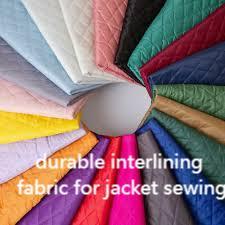
Textile engineers rely on the Interlining to provide support and shape across garments, making that unseen layer essential to fit and functionality. When designers select the right Interlining, they balance stiffness, drape, and thermal properties to meet both aesthetic and practical goals. This article explores how modern interfacings are engineered, tested, and applied across apparel and technical textiles, helping manufacturers, designers, and product managers make smarter material choices.
Materials and Construction Fundamentals
A high-performance interfacing starts with carefully chosen base fibers and bonding systems. Woven, knitted, and non-woven substrates each offer distinct characteristics: woven types deliver dimensional stability, knitted versions provide elasticity and recovery, and non-wovens offer uniform thickness and cost efficiency. Bonding methods — hot-melt adhesives, needle-punching, thermal calendering, or ultrasonic bonding — determine how strongly the layer adheres to face fabrics and how it behaves after laundering. Selecting the correct combination prevents delamination, puckering, and unwanted stiffness in finished garments.
Balancing Structure, Comfort, and Appearance
The primary role of an internal support layer is to improve garment structure without compromising wearer comfort. Interfacings can sharpen collars, support lapels, add opacity to lightweight fabrics, or stabilize seams in high-stress areas. But overly rigid layers ruin drape and feel. Material engineers therefore tune mechanical properties like bending stiffness and tensile strength while keeping surface hand pleasant. Advanced testing—bend tests, hand-feel panels, and wearer trials—helps strike the necessary balance between aesthetic appeal and functional support.
Durability, Care, and Environmental Performance
Long-term product performance depends on both material resilience and care behavior. Modern applications demand that internal layers survive repeated washing, drying, and mechanical abrasion while retaining adhesion and form. Manufacturers use low-migration adhesives, thermally stable polymers, and corrosion-resistant finishes to meet these expectations. Simultaneously, sustainability goals push suppliers to consider recycled fibers, bio-based adhesives, and lower-energy bonding processes. Product specifications increasingly include lifecycle assessments, giving brands the data to choose materials that align with circular-economy targets.
Testing, Certification, and Quality Assurance
Quality control is essential when small internal layers have big visual and structural impacts. Labs perform peel-strength, dimensional stability, and thermal aging tests to ensure batches meet contract requirements. Certifications and documented test reports reduce risk during production ramp-up and help brands demonstrate compliance with safety or market-specific standards. Traceability systems, sample archives, and consistent supplier audits also mitigate variability that can cause costly rework in downstream apparel assembly.
Integrating Interfacings into Product Development (Interlining-Factory Focus)
Close collaboration between material suppliers, pattern cutters, and sewing teams streamlines product development. Prototype iterations with varying interlining weights and bonding methods reveal how seams behave, how edge finishes perform, and how the garment hangs on the body. Using graded interfacings—lighter in shoulders, heavier at collars—optimizes both comfort and appearance. This systems-level thinking shortens development cycles and reduces costly changes after full production begins.
Applications Across Markets and Product Types
Support layers are used far beyond classic tailored suits. In sportswear, engineered interfacings add stability to compression panels while allowing breathability. In outerwear, thermally insulating interlayers contribute to warmth without bulk. Home textiles and automotive interiors use structural layers to maintain shape and resist wear. Technical textiles rely on specialized substrates for flame retardancy, EMI shielding, or moisture control. Each market imposes different priorities—washability, flame performance, or longevity—that guide material selection and bonding strategies.
Practical Tips for Specifiers and Designers
Begin with a clear statement of function: is the layer for shape, insulation, reinforcement, or aesthetics? Test candidate materials with representative face fabrics and perform laundering cycles common to end-use. Communicate tolerances for thickness, stiffness, and adhesion to suppliers and demand batch test reports. Consider modular sourcing strategies—keeping a controlled set of qualified interfacings on contract reduces production variability and speeds procurement for new styles.
Looking Ahead: Smart and Sustainable Interfacings
Innovation in interfacings increasingly embraces smart capabilities: integrated moisture pathways, phase-change materials for thermal buffering, and conductive yarns for sensing or heating. At the same time, process innovations—lower-temperature bonding, solvent-free adhesives, and recycled fiber content—address environmental concerns. These dual trends expand the role of internal layers from invisible support to active contributors in garment performance and sustainability.
Choosing the right internal support layer transforms a good design into a great product. By combining thoughtful material selection, precise bonding methods, and rigorous testing, manufacturers and designers can deliver garments that look better, perform longer, and align with modern sustainability goals. For in-depth technical resources and real-world examples, visit https://www.interlining-factory.com/news/what-is-interlining-types-applications-and-more.html

 English
 Arabic
 French
 Spanish
 Portuguese
 Deutsch
 Turkish
 Dutch
Dutch
 Russian
 Romaian
 Portuguese (Brazil)
 Greek
Greek