


AI in FinTech: Redefining Risk Assessment and Fraud Detection
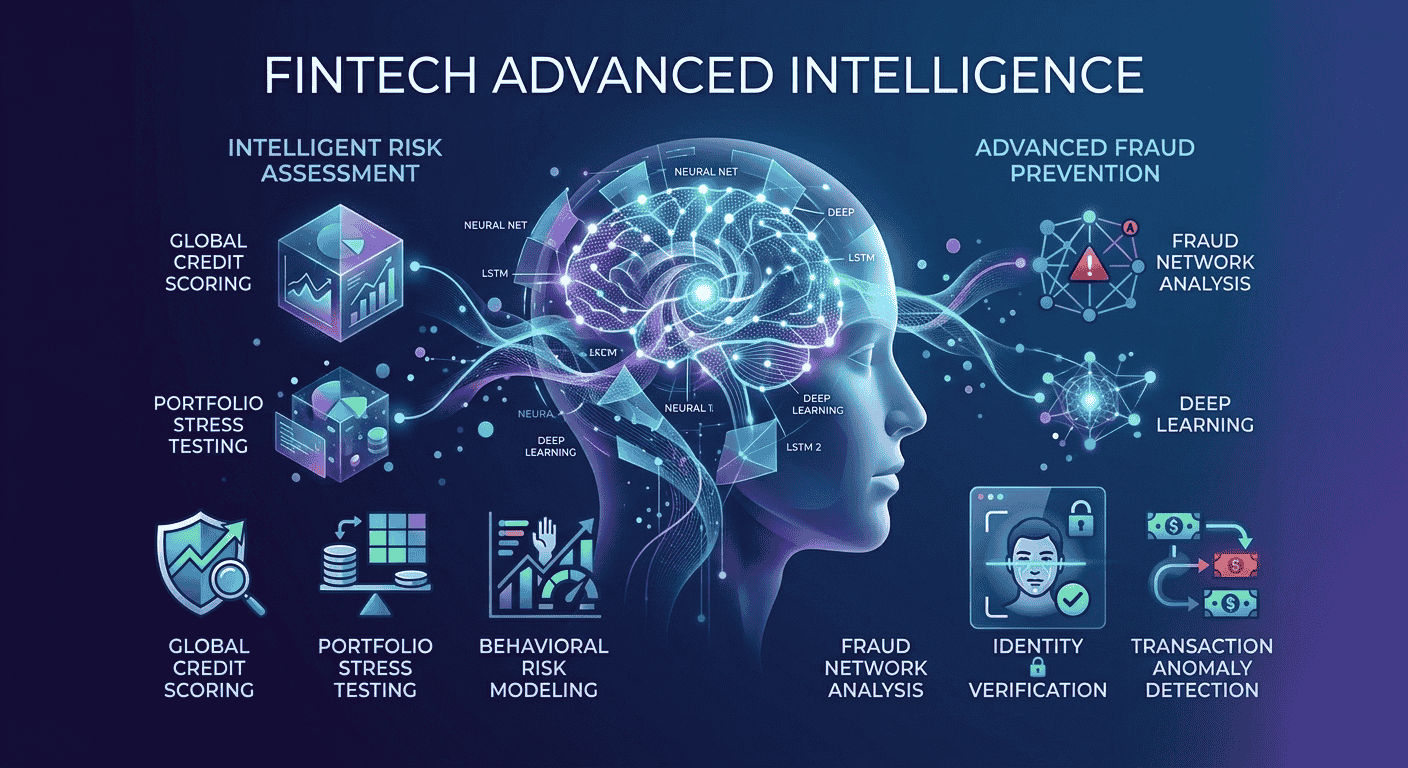
The financial services industry has always relied heavily on data to make decisions. From assessing creditworthiness to identifying suspicious transactions, financial institutions continuously analyze large volumes of information to manage risk and protect customers.
However, traditional analytical methods are no longer sufficient in today’s digital financial ecosystem. The rapid growth of online banking, digital payments, and global financial transactions has significantly increased both data complexity and fraud risks.
Artificial Intelligence (AI) is transforming the financial technology (FinTech) sector by enabling smarter, faster, and more accurate risk assessment and fraud detection systems. AI-powered algorithms can analyze vast datasets in real time, identify hidden patterns, and detect anomalies that would be nearly impossible for humans to identify manually.
In this blog, we explore how AI is reshaping risk assessment and fraud detection in FinTech, the technologies driving this transformation, real-world applications, benefits, challenges, and how financial institutions can strategically implement AI solutions.
The Growing Need for Advanced Risk Management in FinTech
Financial institutions operate in a highly dynamic and risk-sensitive environment. Every transaction carries potential risks, including fraud, credit default, and regulatory violations.
Several trends have intensified these challenges:
Growth of Digital Banking
Mobile banking, digital wallets, and online transactions have expanded rapidly, increasing the number of financial interactions that must be monitored.
Sophisticated Cybercrime
Fraudsters are using increasingly advanced techniques to bypass traditional security systems.
Regulatory Pressure
Financial institutions must comply with strict regulatory frameworks and maintain strong risk management practices.
Massive Data Volumes
Financial systems generate enormous amounts of transactional and behavioral data every second.
AI technologies help organizations process this data efficiently and uncover actionable insights.
How AI Is Transforming Risk Assessment
Risk assessment is a core function of financial institutions. It involves evaluating the likelihood of financial loss and determining appropriate actions to mitigate risk.
AI improves this process in several ways.
Advanced Credit Scoring
Traditional credit scoring models rely on limited financial indicators such as credit history and income levels. AI-powered models analyze a much broader set of variables, including:
- Transaction behavior
- Spending patterns
- Payment history
- Employment trends
- Alternative financial indicators
This allows financial institutions to create more accurate and inclusive credit profiles.
Predictive Risk Modeling
Machine learning algorithms analyze historical data to predict future risks. These models continuously learn and adapt as new data becomes available.
Predictive risk models can help institutions identify:
- Potential loan defaults
- Market volatility risks
- Liquidity challenges
- Investment risks
By anticipating risks earlier, financial organizations can take proactive measures.
Real-Time Risk Monitoring
AI systems can monitor financial activities in real time, providing immediate alerts when unusual behavior occurs.
This capability is especially valuable for:
- Large-scale trading environments
- High-frequency transactions
- Digital payment platforms
Real-time risk monitoring reduces response time and prevents potential losses.
AI-Powered Fraud Detection
Fraud detection has become one of the most important applications of AI in FinTech.
Traditional rule-based systems rely on predefined rules, such as flagging transactions above certain thresholds. However, these systems struggle to detect new or evolving fraud tactics.
AI addresses this limitation through advanced pattern recognition.
Behavioral Analysis
AI models analyze user behavior patterns, including:
- Login activity
- Transaction frequency
- Device usage
- Geographic locations
If a transaction deviates significantly from a user’s typical behavior, the system can flag it for further investigation.
Anomaly Detection
Machine learning algorithms identify unusual patterns within massive transaction datasets.
For example:
- Sudden spikes in transaction amounts
- Transactions from unusual locations
- Rapid multiple transfers between accounts
These anomalies may indicate fraudulent activity.
Adaptive Learning Systems
Fraud tactics evolve constantly. AI systems can learn from new fraud patterns and adapt detection models accordingly.
This continuous learning capability helps financial institutions stay ahead of emerging threats.
Key AI Technologies Used in FinTech Risk Management
Several AI technologies play a critical role in risk assessment and fraud detection.
Machine Learning
Machine learning models analyze historical transaction data to identify risk patterns and predict potential threats.
Deep Learning
Deep neural networks can process highly complex datasets, improving fraud detection accuracy.
Natural Language Processing (NLP)
NLP analyzes text data such as financial reports, customer communications, and regulatory documents.
Graph Analytics
Graph-based AI models detect relationships between accounts, transactions, and entities helping uncover hidden fraud networks.
Predictive Analytics
Predictive algorithms forecast potential risks based on historical data trends.
These technologies work together to create robust financial risk management systems.
Real-World Applications of AI in FinTech
Credit Risk Evaluation: Banks and lending platforms use AI to evaluate borrower risk more accurately, expanding access to credit while reducing default rates.
Payment Fraud Detection: Payment processors deploy AI systems to detect suspicious transactions in real time.
Anti-Money Laundering (AML): AI analyzes financial transaction networks to identify potential money laundering activities.
Insurance Risk Assessment: Insurance providers use AI to assess claim risks and detect fraudulent claims.
Investment Risk Management: Asset management firms use AI models to analyze market trends and optimize portfolio risk strategies.
Benefits of AI in Financial Risk and Fraud Management
Faster Decision-Making
AI systems analyze data at speeds far beyond human capabilities, enabling real-time risk evaluation.
Improved Accuracy: Advanced algorithms detect subtle patterns that traditional systems may miss.
Reduced Operational Costs: Automation reduces the need for manual fraud investigations and risk analysis.
Enhanced Customer Protection: AI systems can detect and prevent fraudulent transactions before they cause damage.
Better Regulatory Compliance: AI-driven monitoring systems help financial institutions meet compliance requirements more efficiently.
Challenges in Implementing AI in FinTech
Despite its advantages, AI adoption in financial services also presents challenges.
Data Quality Issues: AI models depend on accurate and well-structured data. Poor data quality can reduce effectiveness.
Regulatory Concerns: Financial regulators require transparency in automated decision-making systems.
Model Bias: If training data contains biases, AI models may produce unfair or discriminatory outcomes.
Cybersecurity Risks: AI systems themselves must be protected from adversarial attacks and manipulation.
Financial institutions must address these challenges through robust governance frameworks.
Best Practices for AI Implementation in FinTech
Organizations adopting AI should follow several best practices.
Build Strong Data Infrastructure: High-quality data pipelines are essential for effective AI systems.
Ensure Model Transparency: Explainable AI techniques help organizations understand and validate AI decisions.
Implement Continuous Monitoring: AI models should be regularly evaluated and updated to maintain performance.
Strengthen Security Measures: Secure architecture protects AI systems from cyber threats.
Maintain Regulatory Compliance: Clear governance policies ensure alignment with financial regulations.
These practices support responsible and sustainable AI adoption.
The Future of AI in Financial Risk Management
AI will continue to reshape the financial services landscape.
Future developments may include:
- Fully autonomous risk monitoring systems
- AI-powered financial advisors
- Real-time global fraud detection networks
- Predictive regulatory compliance systems
- AI-driven decentralized finance (DeFi) risk management
As financial systems become more digital and interconnected, AI will play an increasingly vital role in maintaining security and stability.
Final Thoughts: Building Smarter and Safer Financial Systems
Artificial Intelligence is redefining how financial institutions manage risk and detect fraud. By analyzing massive datasets, identifying hidden patterns, and adapting to evolving threats, AI provides powerful tools for protecting financial ecosystems.
For FinTech companies and traditional financial institutions alike, investing in AI-driven risk management solutions is becoming essential for maintaining competitiveness and ensuring customer trust.
If you’re planning to develop AI-powered financial applications, fraud detection platforms, or intelligent risk management systems, working with experienced AI developers ensures scalable and secure implementation. At Swayam Infotech, we design and develop advanced AI-driven solutions that help businesses harness data for smarter decision-making and stronger security.

 English
 Arabic
 French
 Portuguese
 Deutsch
 Turkish
 Dutch
Dutch
 Italiano
 Russian
 Romaian
 Portuguese (Brazil)
 Greek
Greek