


Industrial Drones Empower Construction Progress Monitoring in Large-Scale Projects
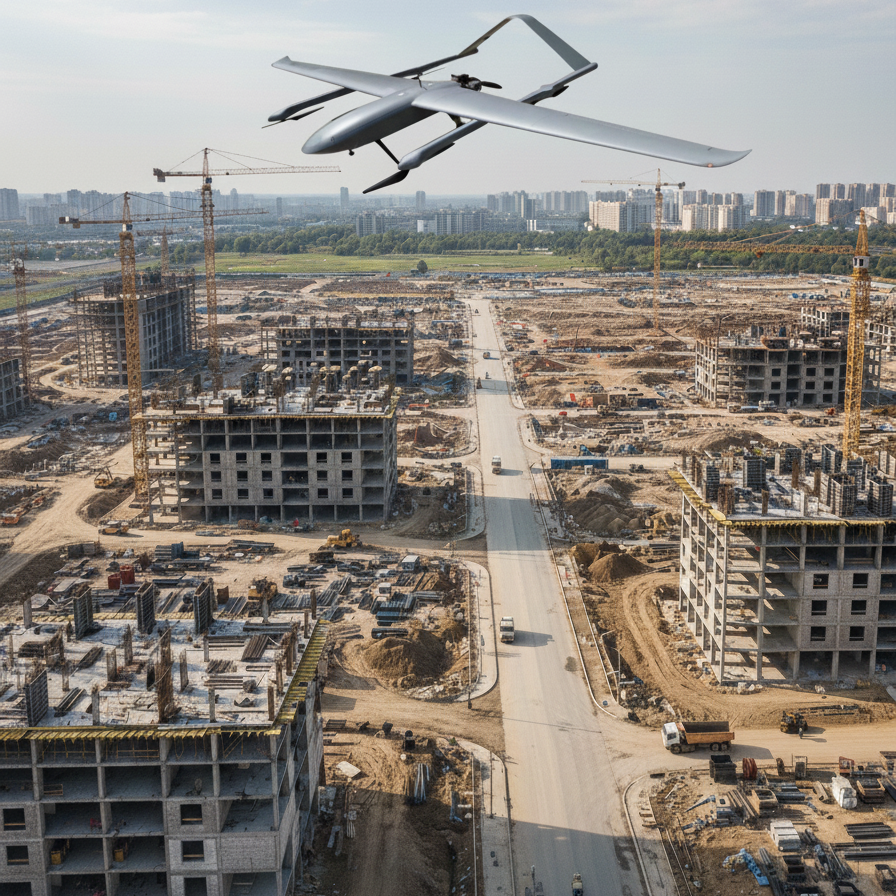
Managing the progress of large-scale construction projects is always a complex challenge. Traditional methods of site inspections, progress tracking, and reporting are time-consuming, labor-intensive, and often prone to errors. Industrial drones (Industrial UAVs) have emerged as a game-changing technology, providing real-time aerial views, accurate data collection, and enhanced project oversight.
Advantages of Industrial Drones in Construction Monitoring
Industrial drones bring multiple benefits to large construction projects:
- Real-Time Progress Tracking Drones capture high-resolution aerial images and videos of the construction site at regular intervals. Project managers can monitor ongoing work, identify delays, and adjust schedules without relying solely on ground-level inspections.
- Accurate Measurement and Documentation Equipped with LiDAR, photogrammetry, or GPS-enabled cameras, drones can measure distances, volumes, and areas accurately. This data helps track earthworks, material usage, and structural progress, reducing human error and improving reporting precision.
- Safety and Accessibility Construction sites often have hazardous zones, such as high-rise structures or areas with heavy machinery. Drones provide safe access to these areas, reducing the need for personnel to enter dangerous zones for inspections.
Case Study 1: High-Rise Building Project
In a metropolitan high-rise construction project, industrial drones were deployed for weekly aerial inspections. By comparing the captured drone imagery against the project schedule:
- Construction progress could be evaluated visually and quantitatively
- Delays in facade installation were detected early
- Managers optimized labor allocation and material delivery
Case Study 2: Large Infrastructure Development
A highway expansion project spanning several kilometers used industrial drones for site-wide monitoring. The drones generated orthomosaic maps and 3D terrain models to track earthworks, bridge construction, and road alignment.
Results:
- Improved coordination across multiple teams and subcontractors
- Reduced rework due to early detection of discrepancies
- Created a digital archive for compliance and reporting
Case Study 3: Real-Time Resource Management
A stadium construction project integrated drone monitoring with BIM (Building Information Modeling) systems. Drones captured frequent site updates, which were automatically uploaded to the BIM platform for progress visualization.
Benefits:
- Instant comparison of planned vs. actual progress
- Enhanced resource scheduling and supply chain management
- Enabled stakeholders to make informed decisions remotely
Key Considerations for Selecting Industrial Drones
When deploying drones for construction progress monitoring, consider the following factors:
- Flight Stability and Weather Resistance – Construction sites may be exposed to wind, dust, and other challenging conditions.
- Payload Options – Cameras, LiDAR, and thermal imaging sensors should match your monitoring needs.
- Flight Time and Range – Long endurance ensures large sites are covered efficiently.
- Data Integration – Drones should support integration with BIM, GIS, or project management platforms for seamless reporting.
Conclusion
Industrial drones are transforming how construction progress is monitored in large-scale projects. By enabling real-time aerial inspections, precise measurements, and data-driven decision-making, drones reduce delays, improve safety, and enhance overall project management. As drone technology continues to evolve, their role in construction monitoring will become even more vital, paving the way for smarter and more efficient building projects.

 English
 Arabic
 French
 Portuguese
 Deutsch
 Turkish
 Dutch
Dutch
 Italiano
 Russian
 Romaian
 Portuguese (Brazil)
 Greek
Greek